
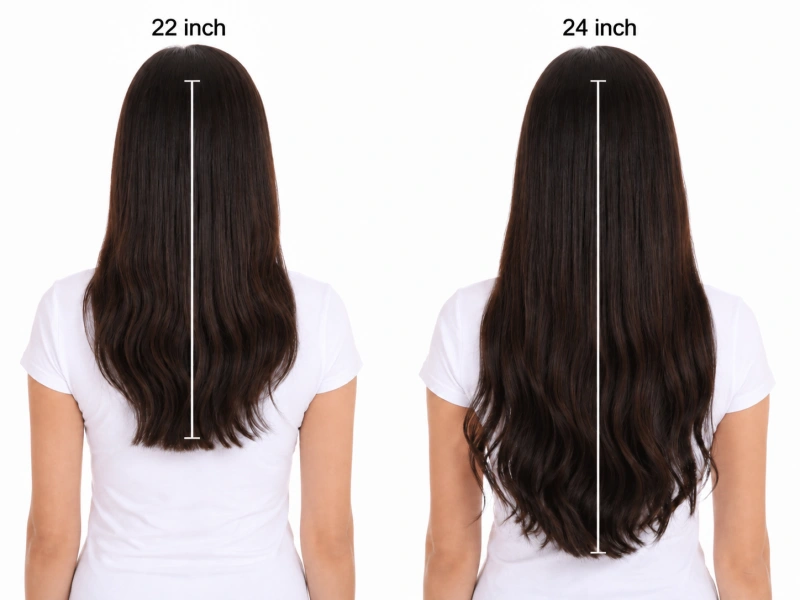
Choosing between 22-inch and 24-inch hair extensions is not simply a question of whether longer is better. The measured difference is exactly 2 inches (5.08 cm): 22 inches equals 55.88 cm, while 24 inches equals 60.96 cm.
Once the hair is installed, however, that difference can look subtle or obvious depending on your height and torso length, where the extensions are attached, the texture you wear, and how full the ends are.
As a practical rule, choose 22 inches when you want a polished long-hair finish with slightly easier daily handling. Choose 24 inches when the final visual length matters more and you are comfortable caring for extra-long hair. Before ordering either length, measure from the point where the extensions will actually sit rather than judging from a model photo alone.
22 vs 24 Inch Hair Extensions at a Glance
| Comparison point | 22-inch hair extensions | 24-inch hair extensions |
| Measured length | 22 in / 55.88 cm | 24 in / 60.96 cm |
| Difference | Baseline | 2 in / 5.08 cm longer |
| Overall effect | Long, polished and versatile | Extra-long and more dramatic |
| Visible difference | More compact long-hair finish | More drop below the 22-inch endpoint |
| Daily handling | Slightly less length to brush, dry and protect | More hair in contact with clothing, seats and bedding |
| Fullness at equal gram weight | Can look fuller through the ends | Can look lighter through the ends if the same weight is spread over more length |
| Best reason to choose it | You want long hair without maximizing length | You want the longest visible finish of the two |
Important: these are general tendencies, not fixed body-placement rules. Texture, installation position, natural haircut, gram weight and end density can change the finished result.
Is a 2-Inch Difference Actually Noticeable?
Yes, but not in the same way on everyone. Two inches sounds small on a tape measure, yet it can change the lower edge of long extensions enough to be visible in a back-view photo, especially when the hair is straight, softly waved, or cut with a full perimeter.
The difference is less obvious when the hair has deep waves, curls, heavy layers or naturally tapered ends. Body proportions matter too. The same 24-inch extension can sit much lower on one person than another because the distance from the attachment point to the waist is different.
That is why fixed advice such as “22 inches is for shorter people” or “24 inches is for taller people” is unreliable. A measurement from your planned attachment point gives you a better answer than a height category.
Where Will 22- and 24-Inch Extensions Fall?
Hair extension length is normally measured from the top of the extension piece, weft or strand to the longest tips. Your installed endpoint therefore depends on where that piece is placed. A row sitting higher on the head will finish lower than the same length installed farther down.
Before you order, use a soft tape measure and mark both 22 inches and 24 inches from the area where your stylist plans to place the extensions. Check the result from the back while standing normally. If you are still unsure, compare the dedicated 22 inch hair length guide and 24 inch hair length guide, but use your own measurement as the final reference.
Five factors have the biggest effect on where the hair appears to end: your torso length, the installation position, the texture, the shape of your natural haircut, and how much the ends are layered or tapered.
Straight, Wavy and Curly Hair Change the Visible Length
Straight hair shows the measured length most literally. If two matched sets are installed at the same point, the 24-inch option will usually show the clearest extra drop.
Wavy hair bends along the strand, so the finished endpoint sits higher than the same hair pulled straight. With curly or coily textures, the visual difference can be larger because the pattern uses more of the strand length. If your supplier measures textured hair stretched, a “24-inch” curly product will not hang 24 inches vertically when it is worn in its finished curl pattern.
For a fair comparison, look at 22- and 24-inch samples in the same texture. Avoid comparing a straight 22-inch photo with a curled 24-inch photo; the styling difference can be more noticeable than the two-inch length difference itself.
Fullness, Gram Weight and End Density Matter as Much as Length
Length and weight are separate specifications. A 24-inch set is not automatically heavier than a 22-inch set. Installed weight depends on the number of grams, pieces, wefts, tapes or individual strands used.
If two sets use the same total gram weight and similar construction, however, the longer option may look lighter through the ends because the hair is distributed over greater length. The drawing standard matters as well. Hair with more short strands through the bundle will look more tapered, while a fuller end-density specification keeps more visual weight near the bottom.
When comparing 22 vs 24 inch hair extensions, check length, gram weight, texture, construction and end density together. This is especially important for shorter or blunt natural hair, where underweight long extensions can create a visible line between the natural perimeter and the extension hair.
Which Length Blends Better With Your Natural Hair?
Neither length is automatically more natural. Blending depends on the gap between your natural haircut and the extension endpoint, plus the amount and placement of extension hair used to bridge that gap.
If your natural hair is already medium to long, both 22 and 24 inches can blend well with appropriate density and cutting. If your natural hair is short, thick or blunt at the ends, the jump to 24 inches may require more careful layering and enough density through the mid-lengths so the transition does not look disconnected.
Color matching matters just as much as length. A perfectly measured 22-inch set with the wrong undertone will look less convincing than a well-matched 24-inch set. Choose the endpoint first, then confirm color, weight and blending with the same level of care.
Styling and Daily Maintenance: 22 vs 24 Inches

Both lengths are long enough for waves, braids, ponytails and updos. The extra two inches on 24-inch hair can make a braid or long wave pattern look more dramatic, but it also gives you slightly more surface area to detangle, dry and protect.
Extra-long hair also tends to contact collars, chair backs, seat belts and bedding more often. That does not mean 24-inch extensions will automatically tangle or wear out quickly. Hair quality, processing, installation, daily friction and home care matter more than a two-inch difference alone.
Whichever length you choose, detangle from the ends upward, support the attachment area while brushing, use heat protection when styling, and follow care instructions for your installation method. For a more complete routine, see Alpha’s hair extension aftercare guide.
Choose 22 Inches If…
- You want a clearly long result but do not need the maximum length of the two options.
- You prefer slightly less hair to brush, dry and manage every day.
- Your current haircut needs a smaller length jump for an easier blend.
- You are comparing equal gram weights and want to preserve more visual fullness at the ends.
- Your tape-measure test shows that 22 inches already reaches the endpoint you want.
If that sounds like your goal, review the available 22 inch hair extensions and confirm the method, weight, texture and color before ordering.
Choose 24 Inches If…
- Your priority is a visibly longer, extra-long finish.
- You want more length for long waves, braids or statement styling.
- Your torso proportions make 22 inches look shorter than you expected after measuring.
- You are comfortable with a little more brushing, drying and friction management.
- Your stylist or supplier can provide enough density for the length to look balanced.
If the lower endpoint is the deciding factor, compare 24 inch hair extensions in the same texture and gram weight you used to evaluate the 22-inch option.
How to Measure Before You Order?
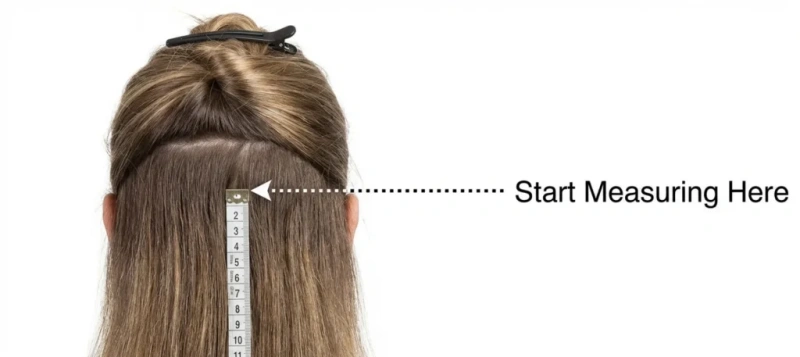
- Choose the real attachment point. Measure from where the weft, tape, clip-in piece or strand will sit, not automatically from the crown.
- Mark 22 inches. Let the tape follow the direction the hair will fall and note the endpoint.
- Mark 24 inches. Extend the tape another 2 inches (5.08 cm) and compare the change.
- Account for texture. If you wear waves or curls, remember that the finished pattern will look shorter than the stretched measurement.
- Confirm the rest of the specification. After choosing length, verify gram weight, attachment method, end density and color. Length alone does not determine the final look.
For salon clients, a quick back-view photo at both measurement points can make the decision easier. Keep the camera angle and posture the same so you are comparing length rather than perspective.
For Salons, Brands and Professional Buyers
When you are building a 22-inch and 24-inch assortment, compare samples like for like. Use the same color, texture, attachment construction and gram weight, then check finished length, top-to-end density, shedding, tangling after a care test, and the consistency of clips, tapes, bonds or wefts. An approved sample and written specification make repeat orders easier to evaluate.
Alpha has manufactured 100% full-cuticle Remy hair extensions and wigs since 1990 and provides OEM/ODM support for hair brands, salon chains and new entrants.
If you are developing 22- or 24-inch SKUs, start with a clear specification for method, color, texture, weight, end density, packaging and quantity, then approve the sample before bulk production. You can also review Alpha‘s hair extension quality control process when defining your inspection points.
FAQ
Is 24-inch hair noticeably longer than 22-inch hair?
Yes. The measured difference is exactly 2 inches, or 5.08 cm. It is usually easiest to see on straight or softly waved hair, but the visual difference changes with texture, layers, attachment position and body proportions.
Do 24-inch hair extensions weigh more than 22-inch extensions?
Not necessarily. Length and gram weight are different specifications. A 24-inch set can weigh less, the same or more than a 22-inch set depending on the product. Compare grams and construction rather than assuming weight from length.
Are 22-inch hair extensions better for shorter people?
Not automatically. On a shorter torso, both lengths may sit lower and look more dramatic. Measure from your planned attachment point and choose the endpoint you prefer rather than using height alone.
How do I compare 22- and 24-inch curly extensions?
Compare the same curl pattern and confirm how the supplier measures the hair. Curly extensions are often measured stretched, so their finished hanging length will be shorter than the stated measurement.
Which length is easier to blend with short hair?
A smaller length jump can be easier to blend, so 22 inches may require less transition than 24 inches. However, the natural haircut, density, installed grams and stylist’s layering plan matter more than length alone.
Should I buy 22 or 24 inch hair extensions?
Choose 22 inches for a balanced long-hair finish with slightly easier handling. Choose 24 inches when visible length is the priority. The most reliable method is to mark both lengths from the real attachment point, then compare the result in your intended texture and density.
Final Answer: 22 or 24 Inches?
There is no universal winner. Twenty-two inches is the practical choice when you want long hair, strong fullness and manageable daily wear. Twenty-four inches is the better choice when you want the extra-long endpoint and are prepared to maintain it.
The two-inch difference matters, but it should not be evaluated on its own. Measure first, then compare the same texture, gram weight, construction and end density. That gives you a much more reliable result than choosing by height, face shape or a single model photo.