
The best hair extension packaging ideas do more than make a product look attractive. They keep the hair organized, help shoppers identify the right shade and method, and support the way you sell—whether that is through a salon, a retail shelf, your own website, or a fulfillment partner.
Below are 15 practical ideas for clip-ins, tape-ins, wefts, bonded extensions, halos, and ponytails. For each option, you will see the products it suits, common materials, a relative cost level, and one detail to check before you approve the design. Use the ideas as a starting point, then size every package around a finished, folded sample rather than the advertised hair length alone.
Relative cost guide: $ = economical; $$ = mid-range; $$$ = premium. These symbols compare formats only. Your final price will depend on dimensions, materials, print, finishes, inserts, quantity, and shipping.
15 Hair Extension Packaging Ideas
1. Magnetic Rigid Box for a Hero Collection
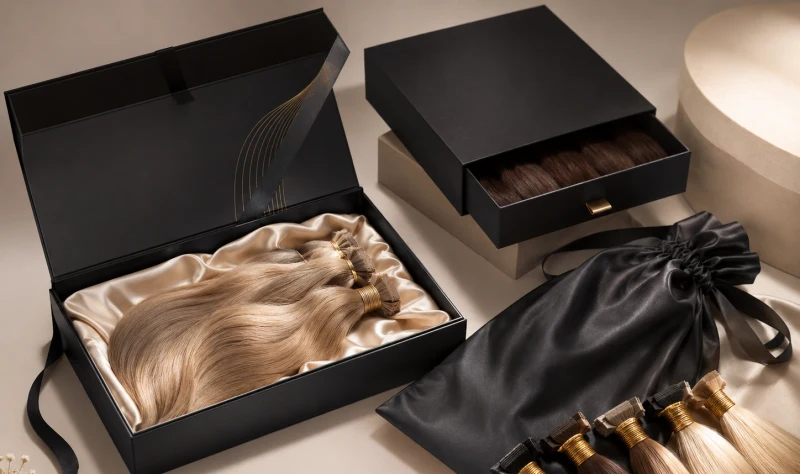
A magnetic rigid box gives a flagship product a strong, gift-ready presentation. It works especially well for premium clip-in sets, full-volume wefts, halos, and curated collections where the package needs to feel substantial when it is opened.
Best for: hero SKUs, launches, influencer kits, and salon retail. Typical materials: wrapped rigid board with a paper, card, or fabric-covered insert. Cost level: $$$.
Keep the insert simple and make sure it holds the hair without pressing clips, bonds, or lace components. A beautifully finished box still fails if the product moves in transit or is difficult to return to storage.
Shipping/display note: Test the packed box inside its actual shipping carton. A rigid presentation box is not automatically a shipping box.
2. Drawer Box for Sets and Accessories
Drawer boxes create a controlled reveal and give you space to separate hair from clips, a brush, a color ring card, or care materials. A ribbon pull can make the opening intuitive, but it should be strong enough for repeated use.
Best for: multi-piece clip-in sets, tool bundles, sample kits, and gift sets. Typical materials: rigid sleeve and sliding tray with a fitted insert. Cost level: $$$.
Plan the tray depth around the thickest packed component. If the drawer is too shallow, the product catches on the sleeve; if it is too deep, the set can feel loose and unfinished.
Tip: Photograph the open and closed package. Your e-commerce listing needs to show both the exterior and the product organization inside.
3. Foldable Rigid Box for Premium E-Commerce
A foldable rigid box can give you a premium surface while reducing the storage volume of empty packaging. It is useful when you want a high-end look but need to manage warehouse space or international freight more carefully.
Best for: growing direct-to-consumer brands and higher-volume premium lines. Typical materials: rigid panels with wrapped paper and a collapsible construction. Cost level: $$–$$$.
The trade-off is assembly. Ask the packing team to test how quickly the box can be formed and whether the corners stay square after repeated handling.
Shipping/display note: Compare the savings on empty-box freight with the extra labor needed to assemble each unit.
4. Lid-and-Base Box for Clean Shelf Presentation
The familiar two-piece lid-and-base format is easy for customers to understand and easy for salons to stack. It can feel premium without the extra mechanics of a drawer or magnet.
Best for: standard wefts, tape-in packs, clip-in sets, and retail bundles. Typical materials: rigid board or sturdy paperboard, with an optional product card or tray. Cost level: $$–$$$.
Use a lid depth that stays secure but does not create suction or make the box hard to open. If you offer several lengths or weights, consistent outside dimensions can simplify shelf presentation while internal inserts change by SKU.
Tip: Put the SKU label on a visible end panel so staff can identify the product without unstacking every box.
5. Hang Card or Display Pack for Fast Retail Identification
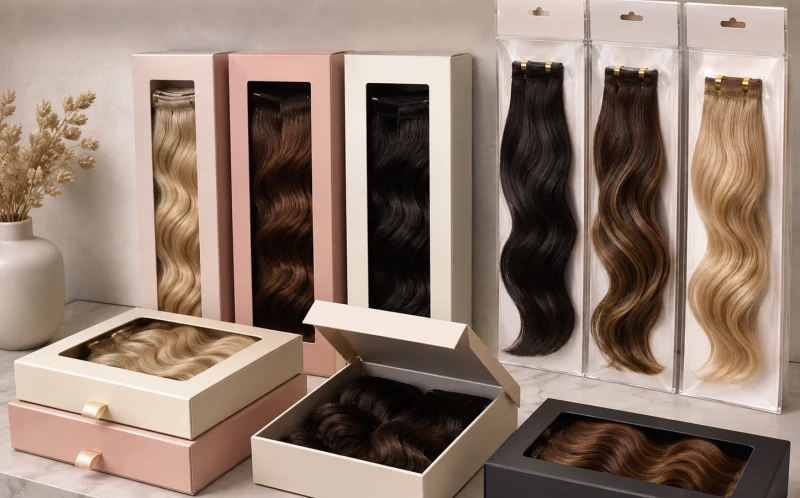
Hang cards put the product at eye level and keep packaging light. They can be paired with a clear sleeve, net, band, or protective back card, depending on how much of the hair you want shoppers to see.
Best for: clip-in hair extensions, tape-in extensions, smaller wefts, and salon displays. Typical materials: printed paperboard, clear sleeve, and a euro-slot or hook. Cost level: $.
The hanging point needs to support the packed weight without tearing. Leave enough flat space for the barcode, color, length, weight, method, and any retailer label.
Shipping/display note: Test the pack on the exact peg or rail used by your retailer; hole position and pack width determine whether products hang neatly.
6. Window Box to Show Shade and Texture
A window box lets the product do part of the selling. Shoppers can see color and texture without opening the package, while the surrounding board gives you space for branding and product information.
Best for: textured extensions, shade-led retail lines, ponytails, and clip-ins. Typical materials: folding carton or rigid board with a die-cut window and an optional transparent film. Cost level: $$.
Place the window where the most representative section of hair sits. If a plastic film is used, check glare in store lighting and in product photography. If you make an environmental claim, identify the actual materials and local disposal conditions instead of calling the whole package “100% eco-friendly.”
Tip: Validate the visible shade under the lighting used in your main sales channel.
7. Satin or Silk-Style Storage Bag
A soft drawstring bag adds a reusable storage layer without a bulky box. It is particularly useful for products customers remove and store between wears.
Best for: clip-ins, halos, ponytails, and premium aftercare kits. Typical materials: satin, silk-style fabric, velvet, or another soft woven material. Cost level: $$.
Choose a fabric and internal finish that will not snag clips or create loose fibers. The bag should be long and wide enough for the hair to lie naturally, and the drawstring should close without catching strands.
Shipping/display note: A pouch protects from dust and tangling but may still need an outer mailer or carton for transit protection.
8. Flat Mailer or E-Commerce Box
For a shipping-first brand, the outer package can also carry the unboxing design. A right-sized corrugated mailer gives you printable surfaces while helping the hair and retail pack stay in position.
Best for: direct-to-consumer orders, subscription shipments, and multiple-SKU orders. Typical materials: corrugated board, paper padding, tissue, or a fitted insert. Cost level: $–$$.
Do not make the mailer larger just to feel luxurious. Empty space usually means more movement, more filler, and higher dimensional shipping weight. Build the experience through clean printing, an organized opening sequence, and useful inserts.
Tip: Run a packing and transit test with the heaviest likely order, not only a single light SKU.
9. Kraft-Look or Recyclable Paper-Based Pack
A natural paper finish can support a restrained, ingredient-led, or sustainability-conscious brand identity. Kraft-look cartons, paper wraps, and molded paper inserts can also keep the design visually simple.
Best for: minimalist lines, refill concepts, salon basics, and brands that can document their material choices. Typical materials: kraft paperboard, recycled-content board, paper bands, and paper inserts. Cost level: $–$$.
Match every claim to the actual specification. “Recyclable where facilities exist” may be more accurate than a blanket recyclable claim, especially when coatings, windows, magnets, foils, or mixed-material inserts are involved.
Shipping/display note: Test scuffing, moisture exposure, and ink rub before approving an uncoated paper surface.
10. QR Care-Card Packaging
A QR code can move detailed instructions off the small package surface and onto a page you can update. Link it to installation guidance, washing and storage instructions, shade support, or a reorder page.
Best for: weft extensions, tape-ins, bonded methods, and products that need specific care. Typical materials: printed card, label, inside-lid panel, or insert. Cost level: $.
Print a short description beside the code so customers know what they will open. Use a stable URL, test the code at final printed size, and keep essential product identification on the physical package.
Tip: Add tracking parameters to the destination URL so you can measure scans without changing the customer-facing design.
11. Sample or Swatch Kit for B2B Buyers
A sample kit helps salon owners, distributors, and brand buyers compare shades, textures, methods, or finishes in a controlled format. It can be compact and practical rather than ornate.
Best for: sales meetings, distributor onboarding, stylist education, and private-label development. Typical materials: ring-bound swatches, labeled cards, compartment trays, or a compact presentation folder. Cost level: $$–$$$.
Give every sample a durable code that matches your order system and online hair extension color chart. If a shade name changes, the reference code should still make the sample usable.
Shipping/display note: Secure each swatch so it can be removed and returned without mixing the sequence.
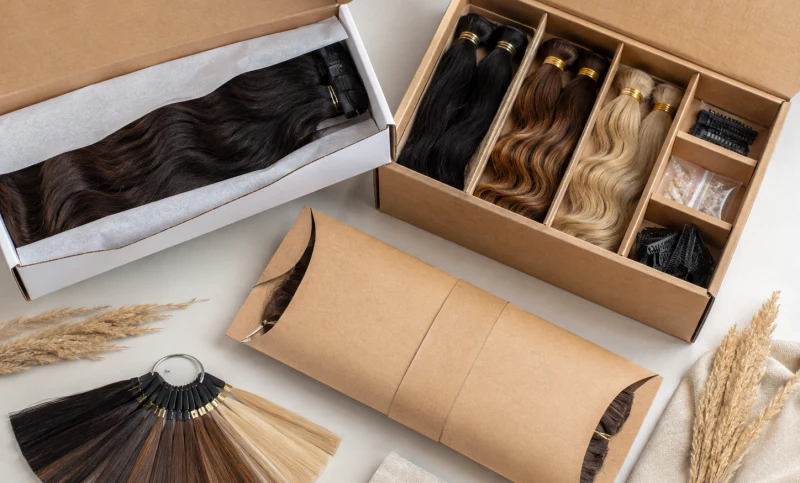
12. Color-Coded SKU Labels
Color coding turns a large extension range into a system customers and staff can scan quickly. Use a small color band or symbol for the method, then keep the actual shade, length, weight, and SKU in readable text.
Best for: brands with many shades, lengths, textures, and attachment methods. Typical materials: printed labels, end-panel stickers, belly bands, or hang tags. Cost level: $.
Do not rely on color alone. Similar shades can look identical in poor light, and color-only systems are harder for some customers to distinguish. Pair color with text and a consistent SKU structure.
Tip: Reserve one location on every package for the variable label so new SKUs do not force a full redesign.
13. Compartment Box for a Complete Set
A compartment box separates the hair from small tools and accessories. It can turn a product into a ready-to-use kit while preventing clips, beads, or tools from rubbing against the hair.
Best for: clip-in sets, installation kits, aftercare bundles, and stylist education packs. Typical materials: rigid or folding box with paperboard dividers, molded inserts, or removable trays. Cost level: $$–$$$.
Every component needs a defined position and restraint. Avoid a deep “catch-all” compartment that looks organized in a mockup but allows parts to move once shipped.
Shipping/display note: Complete a shake test and a full repack test. Customers should be able to return each component without instructions.
14. 3PL- and Marketplace-Ready Packaging
Operational packaging is an idea in its own right. When a third-party warehouse or marketplace handles your stock, clear identification and consistent dimensions can matter more than decorative layers.
Best for: fulfillment centers, wholesale cartons, marketplace inventory, and fast-growing SKU ranges. Typical materials: right-sized retail pack, scannable label, protective outer carton, and case labels. Cost level: $–$$.
Confirm barcode format, label location, carton quantity, SKU naming, and any channel-specific preparation rules before printing. Keep labels away from folds, textured finishes, and curved surfaces that may reduce scan reliability.
Tip: Send a packed production sample—not only artwork—to the fulfillment team for approval.
15. Minimalist Premium Packaging
Minimalism works when the structure, typography, spacing, and finish are deliberate. A limited palette with a blind-embossed logo or one foil accent can feel more confident than a package filled with claims and decorative elements.
Best for: salon-professional ranges, luxury basics, and brands with strong visual identities. Typical materials: rigid board or high-quality folding carton with matte, soft-touch, embossed, or foil details. Cost level: $$–$$$.
Minimal does not mean incomplete. The package still needs a clear SKU, shade, length, weight, method, care access, and business information required for the target market.
Shipping/display note: Approve physical color and finish samples. Small variations are more noticeable when the design uses only one or two colors.
Best Packaging by Hair Extension Type
The right structure depends on what must be protected and how the customer stores the product. Use this comparison to narrow your first sample request.
| Extension type | Good starting formats | Design priority |
| Clip-ins | Hang card, window box, drawer box, storage bag | Keep clips separated from hair; make the set easy to remove and store |
| Tape-ins | Flat carton, hair card, lid-and-base box | Protect adhesive tabs and keep pieces flat and clearly counted |
| Wefts | Lid-and-base box, tray-and-sleeve, mailer | Support the folded weft without crushing texture or creating sharp bends |
| K-tip / I-tip | Labeled cards, narrow cartons, compartment packs | Keep bonds aligned, visible, and separated by shade, length, and quantity |
| Halo | Rigid box, drawer box, soft storage bag | Protect the wire and preserve the curved form without pressure points |
| Ponytail | Window box, hang pack, long storage bag | Show texture while preventing the attachment point from being bent |
For product-specific dimensions, start with a packed sample of the exact SKU. A box that fits a lightweight tape-in set may not fit a dense clip-in set even when both products share the same advertised length. Review the product construction before finalizing packaging for K-tip hair extensions, I-tip hair extensions, halo hair extensions, or ponytail hair extensions.
What Should Be Printed on Hair Extension Packaging?
Your front panel should stay easy to scan. Put detailed information on the back, an end label, or a care card when space is limited. Depending on the product and market, your packaging brief may include:
- Brand name and logo
- Product or collection name
- Extension method, such as clip-in, tape-in, weft, K-tip, or I-tip
- Shade name and color code
- Length, weight, piece count, and texture
- Hair type and any substantiated origin or sourcing statement
- Basic application, care, and storage directions
- Warnings or restrictions that apply to the product or target market
- Batch, lot, or traceability reference where your system uses one
- Barcode, SKU, and optional QR code
- Manufacturer, importer, distributor, or responsible-business details required for the sales market
Check the final copy against the product specification and the rules of every market where it will be sold. Avoid vague quality seals, unverified certifications, and environmental claims that are broader than the material evidence you hold.
How to Turn an Idea Into a Packaging Sample?
You do not need to choose every finish before speaking with a manufacturer. Start with a short brief that explains the product, channel, and customer experience you want.
A useful first brief includes the finished product dimensions, how the hair will be folded, the number of SKUs, the logo files available, preferred colors, sales channel, destination market, target cost level, shipping method, barcode needs, and desired launch date.
Then review the design in stages: structural fit, artwork, physical sample when required, packed-product test, and final approval. Keep comments tied to specific versions so the approved logo position, color, label, and insert are easy to verify during quality control.
Practical sample check: Open and close the package several times, remove and repack the hair, scan the barcode and QR code, inspect the product after a transit test, and photograph it under the lighting used for your sales channel.
Checklist Before Ordering Custom Hair Extension Packaging
Before you request a quote or sample, confirm the following:
- The exact product and finished folded dimensions for each packaging family
- Which SKUs can share one box size and which need a different insert or label
- The sales channel: salon, retail peg, shelf, e-commerce, wholesale, or 3PL
- The package structure, insert, closure, and storage function
- Logo files, brand colors, fonts, and approved product copy
- Print finishes and which surfaces receive them
- Variable fields such as shade, length, weight, piece count, and barcode
- Target market and any labeling or environmental-claim checks required
- Relative cost target, order quantity, sampling needs, and delivery destination
- Outer-carton protection and the transit test you will use for approval
The goal is not to choose the most expensive box. It is to choose a format that keeps the hair presentable, fits your sales channel, and makes the SKU easy to identify. If you need help comparing structures, finishes, samples, and private-label options, explore Alpha Hair’s custom hair extension packaging service.
Final Takeaway
Strong hair extensions packaging design starts with the product, not the decoration. First decide how the hair must sit, what the customer needs to see, and how the order will be stored and shipped. Then choose the box, bag, card, insert, finish, and labeling system that support those needs.
Use luxury hair extension packaging for products and channels that can carry the extra structure and cost. Use lighter cards, cartons, labels, and mailers when fast identification and efficient fulfillment matter more. Whichever direction you choose, approve the final design with a real packed sample and keep every claim specific, readable, and verifiable.