
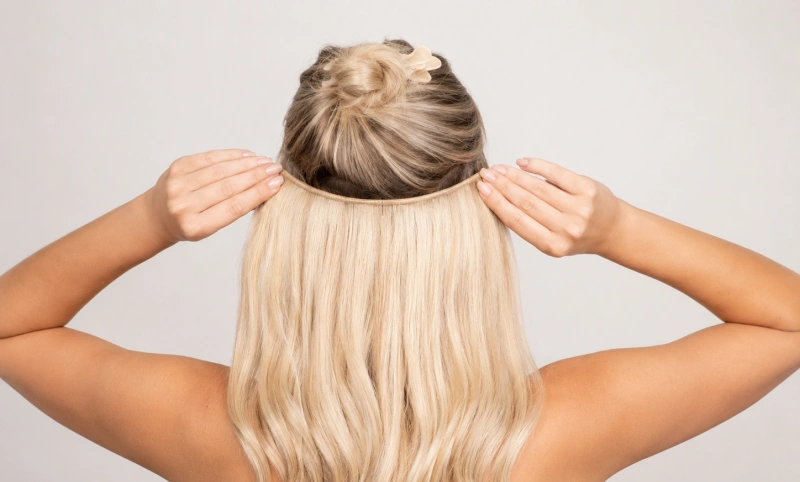
Halo hair extensions work by suspending one hair weft from a thin, adjustable wire that rests around the crown of your head. The weft sits across the back of your head, while a top layer of your natural hair is pulled over the wire to hide it. When the wire is the right length and the weft is positioned correctly, the piece stays balanced without glue, tape, heat, or permanent bonds. You can put it on at home, blend it with your own hair, and remove it whenever you are finished wearing it.
Key Takeaways
- A halo is usually one weft attached to an adjustable transparent wire.
- The wire carries and distributes the weft’s weight around the crown; it should feel snug, not tight.
- A common starting point is 1–2 inches behind the hairline, with the weft sitting securely below the occipital bone at the back.
- Your natural hair covers the wire and weft edge, while optional clips can add grip when needed.
- The best result depends on correct wire size, placement, hair density, color match, and blending—not on pulling the wire tighter.
What Is a Halo Hair Extension?
A halo hair extension is a removable, one-piece extension made from a hair weft and a clear wire. Unlike tape-ins or bonded extensions, it does not need adhesive or a salon installation. Unlike a full clip-in set, it usually has one main piece to position. If you want a broader introduction to the construction, use cases, and basic pros and cons, read What Are Halo Extensions?.
The simple construction is important: the wire and weft work together as a balanced loop. The wire supports the front and sides of the loop, while the hair-bearing weft provides length and volume at the back and sides. Some designs also include removable clips, but the wire remains the main support system.
How Do Halo Hair Extensions Work?
The Invisible Wire Distributes the Weight
The transparent nylon wire rests against the head like a very light headband. Because it connects to both ends of the weft, the extension’s weight is spread around the curve of the head instead of being concentrated on a few bonded strands. This is why a properly sized halo can feel gentler than methods that attach directly to small sections of natural hair.
That does not mean fit is irrelevant. A wire that is too short can create pressure, while a wire that is too long lets the weft drop or slide. If tension or hair health is your main concern, see Do Halo Extensions Damage Hair? for a fuller discussion of safe wear and realistic limits.
The Weft Rests Against the Shape of Your Head
At the back, the weft should sit flat and feel supported by the natural curve below the occipital bone—the small rounded area above the nape. This position helps stop the piece from drifting downward. Head shape varies, so treat this as a starting point rather than a rigid rule. The correct position is the one where the weft lies flat, the side edges do not flare out, and the wire stays comfortable.
Your Natural Hair Hides the Attachment
After placement, you pull a thin, even layer of natural hair out from under the wire with your fingers or a tail comb. That hair falls over the wire and top edge of the weft, making the attachment difficult to see. It also adds light friction, but it should not be used to force an incorrectly sized halo to stay on.
Optional Clips Add Grip
Removable clips can add stability for very smooth hair, an active day, or a head shape that gives the wire less natural support. They are an extra security feature, not a substitute for correct sizing. Secure them only after you have pulled your natural hair over the wire, so the top layer can lie smoothly.
How to Put On Halo Hair Extensions?
You do not need special tools, but a mirror and tail comb make the first few applications easier. Follow these six steps when learning how to put on halo hair extensions.
1. Brush Your Natural Hair and the Extension
Remove tangles before fitting the piece. Smooth hair lets the wire sit evenly and makes it easier to pull small sections over the attachment later.
2. Adjust the Wire Before Styling
Start with the manufacturer’s recommended wire length. Place the halo on your head and check the tension. It should sit close to the scalp without pinching, leaving a deep mark, or creating a headache. If it drops easily, shorten the wire one setting at a time. If it feels tight, lengthen it.

3. Position the Wire and Weft
Place the wire roughly 1–2 inches behind your front hairline. Guide the weft down at the back until it lies flat below the occipital bone rather than floating high on the crown or hanging at the nape. Check both side edges in a second mirror if possible.
4. Pull Your Hair Over the Wire
Use the pointed end of a tail comb or your fingers to lift small sections of hair that are trapped under the wire. Work around the head until the wire and the top seam of the weft are covered. Avoid yanking large sections, which can disturb the fit.
5. Blend the Lengths
Brush your natural hair and the extension together from the mid-lengths downward. Add a loose wave or soft bend if the textures need help blending. If your own ends are blunt, the extension may need face-framing or light layering by a stylist.
6. Do a Movement Check
Turn your head, look down, and gently shake your hair. The halo should stay in position without pressure. If it moves, recheck the wire length and rear placement before adding clips. If it hurts, remove it and loosen the fit rather than trying to get used to the discomfort.

Why Do Halo Hair Extensions Stay in Place?
A well-fitted halo stays in place because three factors work together: the wire matches the circumference of your head, the weft rests against the back curve below the occipital bone, and your natural hair covers the attachment. The weight is balanced around the loop instead of hanging from one point. Optional clips add localized grip when the design or wearer needs it.
A halo can still move if the wire is too long, the weft is sitting too low, the side tabs are not flat, or too little natural hair has been pulled over the piece. Very silky hair and vigorous movement can also reduce friction. Solve the fit first; then use clips if the product includes them.
How Tight Should the Halo Wire Be?
The wire should feel secure but almost forgettable. You should be able to move your head normally without the extension dropping, yet you should not feel pinching, a concentrated pressure point, or a headache. A visible scalp indentation, soreness, or pain means the fit is too tight or the piece may be too heavy for comfortable wear.
If the halo pops upward or rolls back, do not automatically tighten it. The wire may actually be too short, or the rear weft may be sitting too high. If the weft hangs low toward the nape, the wire is often too long. Make one change at a time and retest the position.
How to Blend Halo Hair Extensions Naturally?
Match the Mid-Lengths and Ends
Choose color by looking at the mid-lengths and ends, not only the roots. A small shade difference can look like dimension, but a strong mismatch makes the weft visible even when the wire is hidden. Texture matters too: straight extension hair under very curly or frizzy natural hair will separate visually unless both are styled into a compatible finish.
Match the Density
More grams are not always better. A heavy, dense weft under fine hair can create a shelf at the back or leave too little natural hair to cover the seam. Thick hair may need more density to avoid thin-looking ends. For a natural result, the extension’s weight should match the amount of hair available to cover and blend it.
Soften Blunt Lines
Short or blunt natural ends can sit like a visible line over longer extension hair. Soft layers, face framing, or gentle waves help connect the two lengths. Keep this page focused on fitting; for a complete technique, see our guide to halo hair extensions for short hair and our separate guide on how to cut halo extensions.
Common Halo Fit Problems and Fixes
| Problem | Likely cause | What to try |
| Wire is visible | Too little hair covers it; wire is too close to the part | Use a tail comb to release a thin, even layer over the wire; slightly adjust the front position. |
| Halo slips down | Wire is too long; weft is below its support point | Shorten one setting and reposition the weft so it sits flat below the occipital bone. |
| Halo pops up or rolls back | Wire may be too short; weft may be too high | Lengthen one setting and guide the back of the weft lower before retesting. |
| Side edges flare out | Wire angle or weft position is uneven | Center the weft, flatten both sides, and pull hair over the attachment evenly. |
| Headache or pressure | Wire is too tight or the weft is too heavy | Remove the piece, loosen the wire, and reassess the weight; do not continue wearing a painful fit. |
| Obvious shelf at the back | Too much density or not enough cover hair | Choose a lighter density, add soft layers, or ask a stylist to customize the weft. |
| Ends do not blend | Color, texture, or cut does not match | Match the mid-lengths, soften blunt ends, and style both your hair and the extension together. |
Halo vs. Clip-In Extensions: How the Attachment Differs
Both methods are removable, but the attachment system is different. A halo uses one wire-supported weft, while a clip-in set distributes several wefts across multiple clips. That changes the fitting process more than it changes the basic goal of adding length and volume.
- Support: A halo relies mainly on an adjustable wire around the crown; clip-ins attach directly to sections of natural hair.
- Placement: A halo uses one main piece across the back and sides; clip-ins use several wefts positioned in rows.
- Fit: A halo depends on wire length, rear position, and balanced density; clip-ins depend on section size, clip spacing, and even distribution.
- Styling: A halo is fastest for hair worn mainly down or in lower styles; clip-ins offer more placement control for varied styles.
For a broader buying comparison—not a repeat of this fitting guide—read Halo vs. Clip-In Hair Extensions or review the full pros and cons of halo hair extensions.
Manufacturer Insight: What Makes a Halo Work Better?
For salon brands, retailers, and private-label buyers, a good user experience starts with product engineering. The same halo can feel completely different when the wire, weft, and hair density are not designed as one system.
- Wire options: Offer practical adjustment points or multiple wire lengths so users can fit different head shapes without over-tightening.
- Weft shape: A curved, flexible base should sit flat instead of creating rigid side tabs or a bulky ridge.
- Weight and density: Match gram weight to length and intended customer density; heavier is not automatically more natural.
- Hair quality and direction: Full-cuticle Remy hair with aligned cuticles helps reduce tangling and supports repeated styling.
- Color range: Strong mid-length and end matching reduces returns and makes the attachment easier to disguise.
- Optional security: Removable clips can serve customers who want extra grip without making clips mandatory for every wearer.
Alpha has manufactured human hair products since 1990 and supports OEM/ODM development for brands, salon chains, distributors, and new entrants. Explore our wholesale halo hair extensions for custom wire, length, weight, color, packaging, and sample options.
FAQ
Where should the wire sit on your head?
A useful starting point is about 1–2 inches behind the front hairline, with the weft sitting flat below the occipital bone at the back. Adjust for your head shape until the piece feels balanced and the side edges lie flat.
Can halo hair extensions slip or fall out?
They can move when the wire is the wrong length, the weft is placed too low or high, or the piece is too heavy for the fit. Correct sizing and placement usually solve the problem; optional clips can add security for very smooth hair or more active wear.
Do halo extensions work on thin hair?
They can, but the weft must be light enough for the available cover hair. A bulky, dense piece can show through or create pressure. Choose a density that adds volume without overwhelming your natural hair, and stop wearing the piece if it causes discomfort.
Can you wear halo extensions with short hair?
Yes, but blunt ends often need more blending than long, layered hair. A color match, suitable density, face framing, and soft texture help. See the dedicated short-hair halo guide for detailed techniques.
Can you style halo hair extensions?
Human hair halo extensions can usually be curled or straightened with suitable heat protection and temperature control. Styling limits depend on how the hair was processed, so follow the supplier’s instructions. For practical looks, visit How to Style Hair With Halo Extensions.
Can you wear a halo in a ponytail?
Low or mid ponytails are often easier because they disturb the wire less. Higher styles may need a different securing method. Follow the dedicated tutorial on how to wear halo extensions in a ponytail rather than forcing the standard wire position into every hairstyle.
Do you need clips with a halo extension?
Not always. Some halos are designed to rely mainly on the wire, while others include clips as part of the standard design. Use clips for extra grip when needed, but first make sure the wire length and rear placement are correct.
How do you remove a halo extension?
Open any optional clips, hold the weft at both sides, and lift the piece up and away from the head. Do not pull it through tangled hair. Brush the extension gently before storing it so the wire and weft are ready for the next wear.
Final Answer
So, how do halo hair extensions work? A transparent wire supports a single weft around the crown, the back of the weft rests against the natural shape of the head, and your own hair covers the attachment.
The piece should stay balanced because of fit and placement—not because the wire is painfully tight. Once you size the wire, position the weft, release your cover hair, and blend the lengths, you can add removable length and volume in a few minutes.
For brands and salon businesses: request a custom halo extension sample to evaluate wire fit, weft weight, color, and packaging before bulk production.