
A 22-inch hair length equals 55.9 cm. On most adults, straight 22-inch hair falls somewhere between the mid-back and waist. The exact landing point changes with height, torso length, texture, and where the hair is measured from. Wavy hair appears a little shorter; curls can look much shorter until the strand is stretched.
That variation is why two people can order the same length and see different results. It is also why a wig, a clip-in set, and a professionally installed weft should not be judged from one generic length chart. This guide explains the differences so you can choose 22 inches with realistic expectations.
Quick answer: Choose 22 inches if you want clearly long hair with room for waves, braids, ponytails, and layered cuts, but do not want the extra care of 24 inches or more. If easy daily wear matters more than maximum length, 20 inches is often the safer choice.
What Does 22-Inch Hair Look Like?

Twenty-two inches sits in the long-hair range. On a person of average height, a straight extension usually reaches the mid-back or approaches the waist. On a petite frame it may fall at the waist or lower; on a taller person or someone with a long torso, it can finish closer to the mid-back.
Texture changes the visual result even when the strand measures a true 22 inches. A straight strand shows nearly all of its length. Waves use some of that length in bends, while curls use more in their pattern. Product photos should therefore be treated as a reference, not a promise of an exact body landmark.
| Height reference | Straight | Wavy | Curly |
| Under about 5’3″ / 160 cm | Often near the waist | Upper waist to lower back | Usually mid- to lower back |
| About 5’3″-5’7″ / 160-170 cm | Mid-back to waist | Mid- to lower back | Usually mid-back |
| Over about 5’7″ / 170 cm | Usually mid-back | Upper to mid-back | Often above the straight placement |
These ranges assume the hair is measured correctly and installed near the usual attachment area. Torso length, head size, layers, curl pattern, and the position of the longest strand can shift the result.
How to Measure 22-Inch Extensions and Wigs Correctly?
Measurement method is the missing detail behind many contradictory length charts. The starting point is different for each product, so use the method that matches what you are buying.
| Product | Start | Finish | Best practice |
| Clip-in or weft | Top seam or weft edge | Longest ends | Lay flat; measure the hair, not the clips. |
| Tape-in | Top edge of the tape tab | Longest ends | Measure one clean piece before installation. |
| K-tip or I-tip | Top of the bond or tip | Longest ends | Do not include packaging or loose tie material. |
| Wig | Crown of the cap | Longest ends at the back | Follow the hair’s direction from crown to tip. |
| Wavy or curly hair | Product-specific start | Stretched longest ends | Gently extend the pattern; do not pull hard. |
Use a soft tape measure and take the reading twice. If the ends are layered, measure to the longest natural point rather than counting a few isolated strands. For wigs, see Alpha’s wig length chart for a broader view of crown-to-tip measurements.
Straight, Wavy, and Curly: The Same Length, a Different Effect
Straight 22-inch hair
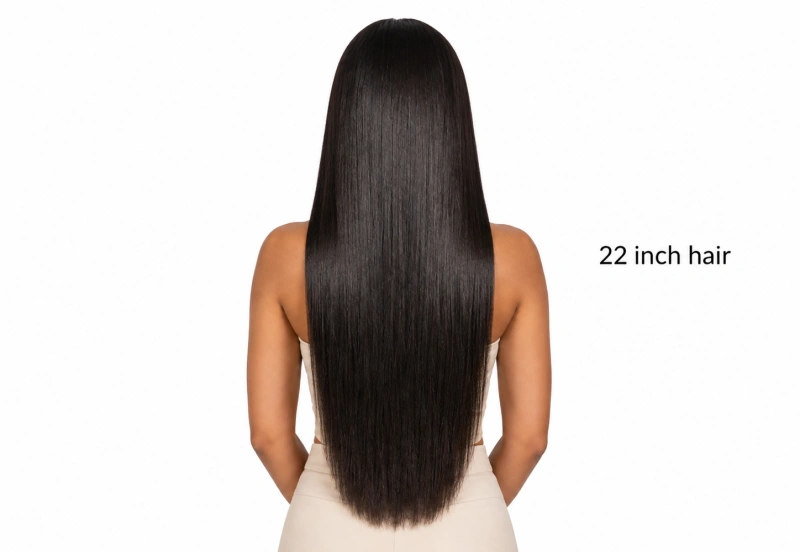
Straight hair displays the full length and usually gives the sleekest, most dramatic result. It is the easiest texture to compare against a ruler or chart. Because long straight ends can look thin when the density is low, the cut and fullness at the bottom matter as much as the number on the label.
Wavy 22-inch hair
Loose or body waves appear slightly shorter but create more movement and visual fullness. A 22-inch wavy set is a useful middle ground for clients who want long hair without the sharp, linear look of straight extensions.
Curly 22-inch hair
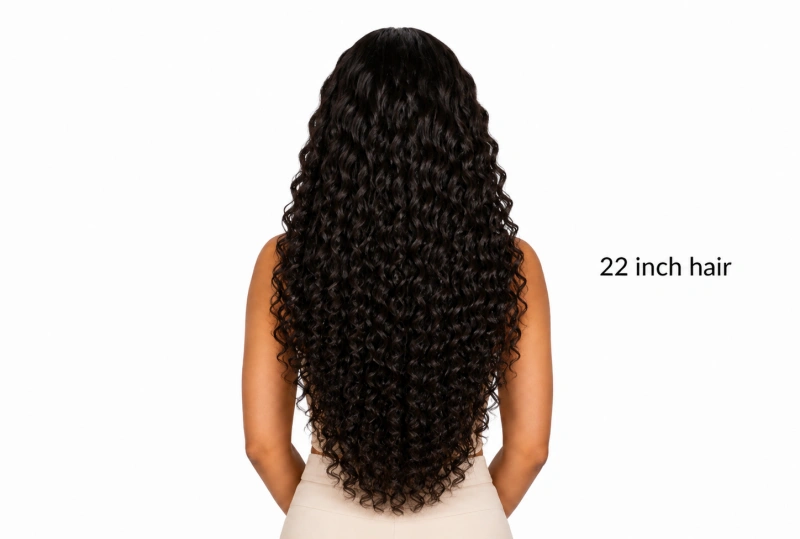
Curly hair can sit several inches higher in its resting shape, depending on how tight the curl is. The advertised length normally refers to the strand when gently stretched. Always compare curl pattern, stretched length, and finished placement before ordering; ’22-inch curly’ is not one universal silhouette.
20 vs 22 vs 24 inches
Two inches sounds small on a tape measure, but it is visible at the ends and noticeable in daily handling. The right choice depends on the finished look, not on choosing the largest number.
| Length | Typical straight placement | Overall effect | Best suited to |
| 20 inches | Mid-back on many wearers | Long but easier for everyday use | Lower maintenance or first-time wearers |
| 22 inches | Mid-back to waist | Clearly long, with strong styling range | A glamorous result without going ultra-long |
| 24 inches | Lower back to waist or beyond | Maximum drama and movement | Clients comfortable with more detangling and care |
For a closer comparison, review the 20-inch hair length guide and the 24-inch hair length guide. Keep the same texture, installation point, and model height when comparing photos.
Is 22 Inches the Right Length for You?
Twenty-two inches works best when the desired result is unmistakably long. It gives stylists enough length for soft layers, big waves, braids, high ponytails, and half-up styles. It also demands more brushing, drying time, and attention around collars, bags, and sleep than a medium length.
Choose 22 inches if you:
- want a visible transformation rather than a subtle change;
- regularly wear waves, curls, braids, or long ponytails;
- are comfortable detangling the mid-lengths and ends every day;
- can support the required weight for your natural density and installation method;
- want a length that photographs as long without moving into 24- to 26-inch territory.
Consider 18 or 20 inches if you:
- have very fine, fragile, or actively shedding natural hair;
- want fast washing and styling;
- exercise, swim, or work in heat and humidity often;
- are new to extensions and unsure about the weight or upkeep;
- prefer a subtle blend rather than a long-hair statement.
| Stylist note: Length should never override scalp and hair health. A trained stylist should assess density, strand strength, scalp condition, and the total weight per attachment point before a permanent or semi-permanent installation. |
Which Extension Method Works Best at 22 Inches?
| Method | Good fit | 22-inch consideration |
| Clip-ins | Occasional wear and a low-commitment length test | Remove before sleeping; distribute clips so one area is not overloaded. |
| Tape-ins | A flat, flexible result for fine-to-medium density | Keep oils and conditioner away from the adhesive area. |
| Wefts | Clients seeking strong volume and a continuous curtain of hair | Row placement and weight distribution should be planned by a professional. |
| K-tip / fusion | Custom strand-by-strand movement and long-term wear | Application and removal require trained hands; bonds are not one-size-fits-all. |
| Wig | A complete length, color, or texture change | Cap fit, density, crown measurement, and fiber type affect the final look. |
Explore Alpha’s clip-in hair extensions, tape-in human hair extensions, weft extensions, and K-tip hair extensions to compare construction and application.
How Many Grams Do You Need for 22-Inch Hair Extensions?
There is no honest universal answer. The required weight depends on the wearer’s natural density, head size, starting length, extension method, desired finish, and how full the hair is from mid-length to ends. Longer hair needs enough material at the bottom to avoid a thin or stringy result, but adding too much weight can stress the natural hair.
As a broad planning range, many full-head 22-inch transformations use roughly 150-200 grams. Fine hair or a volume-only result may need less; thick, blunt natural hair or a high-volume finish may need more. The final decision should be made by method and attachment load, not by copying a number from another client.
Use Alpha’s how many grams of hair extensions do I need? guide as a starting point, then confirm with a stylist or supplier using photos and natural-hair measurements.
How to Keep 22-Inch Hair Looking Good?
- Detangle from the ends upward. Support the attachment area with one hand and use a brush designed for the method.
- Wash the scalp and attachments gently. Do not pile long hair on top of the head, where it can knot.
- Condition the mid-lengths and ends. Keep rich products away from tape, bonds, and other attachment points unless the manufacturer says otherwise.
- Dry the attachment area fully. Sleeping with damp extensions increases matting and puts unnecessary tension on the installation.
- Use heat protectant and moderate temperatures. Human hair can be heat-styled, but repeated high heat shortens its usable life.
- Secure long hair in a loose braid or low ponytail at night and use a smooth pillowcase or bonnet.
- Remove clip-ins before sleep, showering, or swimming. Store them clean, dry, and detangled.
What to check before buying
A useful product page should show more than a length label. Ask for information that lets you predict the finished result and compare suppliers fairly.
- Measurement standard: Where does the supplier start and stop the tape measure?
- Texture condition: Is curly or wavy hair measured stretched?
- Net hair weight: Does the listed weight include clips, tape, bonds, packaging, or only hair?
- End fullness: Are the ends naturally tapered, single drawn, or double drawn?
- Fiber and cuticle claim: Is the product Remy human hair, non-Remy hair, a blend, or synthetic?
- Color evidence: Are shade photos taken in consistent light, and are physical color rings or samples available?
- Quality control: Can the supplier provide batch samples, test reports, or pre-shipment inspection details?
For shade planning, compare against Alpha’s hair extension color chart in natural light and match the mid-lengths and ends, not only the roots.
Best Hairstyles for 22-Inch Hair
The advantage of 22 inches is usable styling room. A center-parted straight finish shows the full length. Loose waves add width and movement, while a long layered cut prevents the ends from looking heavy. Braids and half-up styles keep the hair controlled without hiding the length. High ponytails make a strong statement, but the attachment method must allow the hair to change direction comfortably.
For a realistic before-and-after, record the model’s height, natural starting length, texture, extension method, total grams, and whether the finished hair was cut or layered. Those details make the result far more useful than a beauty photo with no context.
FAQ
Is 22 inches considered long hair?
Yes. Twenty-two inches is firmly in the long-hair range and usually reaches the mid-back or waist when straight, depending on the wearer and measurement point.
How many centimeters is 22-inch hair?
Twenty-two inches equals 55.88 centimeters, usually rounded to 55.9 or 56 cm.
Where does 22-inch hair fall on someone who is 5’2″?
On a 5’2″ person, straight 22-inch extensions often approach the waist. A short torso can make them look longer, while waves, curls, layers, and a lower or higher installation point change the placement.
How long is a 22-inch wig?
A 22-inch wig is normally measured from the crown of the cap to the longest ends at the back. On many wearers it falls around the upper- to mid-back, but cap shape, head size, texture, and layers affect the result.
Do 22-inch curly extensions look shorter?
Yes. Curl and coil patterns create visual shrinkage. The strand can measure a true 22 inches when gently stretched while resting much higher on the body.
Are 22-inch clip-in hair extensions too heavy?
Not necessarily. Comfort depends on total weight, number of clips, placement, and natural-hair strength. A well-distributed set can feel comfortable; a heavy set concentrated in a few clips may not.
How long do 22-inch human hair extensions last?
Length alone does not determine lifespan. Fiber quality, method, wear frequency, heat, washing, maintenance, and removal all matter. Clip-ins used occasionally may last much longer than a set worn every day.
Final take
Twenty-two inches is a strong choice for clients who want a visible, versatile long-hair result. The most important step is not choosing the number; it is confirming how the product is measured, how the texture changes the apparent length, and how much weight the natural hair can support.
Alpha Hair Extension has manufactured full-cuticle Remy extensions and wigs since 1990, with OEM and ODM support for brands, salon chains, retailers, and new market entrants. For custom lengths, textures, colors, packaging, or batch samples, explore our wholesale 22-inch hair extensions or contact the Alpha team for a product recommendation.
Straight 22-inch hair
Straight hair displays the full length and usually gives the sleekest, most dramatic result. It is the easiest texture to compare against a ruler or chart. Because long straight ends can look thin when the density is low, the cut and fullness at the bottom matter as much as the number on the label.
Wavy 22-inch hair
Loose or body waves appear slightly shorter but create more movement and visual fullness. A 22-inch wavy set is a useful middle ground for clients who want long hair without the sharp, linear look of straight extensions.
Curly 22-inch hair
Curly hair can sit several inches higher in its resting shape, depending on how tight the curl is. The advertised length normally refers to the strand when gently stretched. Always compare curl pattern, stretched length, and finished placement before ordering; ’22-inch curly’ is not one universal silhouette.