
For a hair extension salon, the best email marketing does not begin with a newsletter. It begins with the service record. When you know what method a client wears, when it was installed, when the stylist wants to see that client again, and what care advice was given, you can send useful messages at the moments that matter.
That turns email from a stream of generic promotions into a client-retention system. A new client receives preparation guidance. A recent installation client receives aftercare support. A maintenance client receives a reminder based on the date recommended by the stylist. A lapsed client receives a thoughtful invitation to return.
This guide shows you how to build that system, with eight automated flows, four targeted campaigns, copy-ready templates, a 30-day calendar, and a simple measurement plan designed specifically for hair extension salons.
Quick Answer: What Should a Hair Extension Salon Email?
Start with four data points: client permission, extension method, last service date, and the next maintenance date recommended by the stylist. Use them to automate welcome, appointment-preparation, aftercare, rebooking, cancellation-recovery, reinstall, birthday, and win-back emails.
Keep promotional broadcasts limited and segmented. Every message should help the client take one clear action: prepare, care, book, review, refer, or reply.
Key Takeaways
- Use the stylist-selected next-service date instead of applying one maintenance interval to every client.
- Separate clients by extension method and lifecycle stage before writing campaigns.
- Make triggered emails the foundation; use broad newsletters only when the content is genuinely relevant to most recipients.
- Send one primary call to action per email, usually Book maintenance, Schedule a consultation, View aftercare, or Reply to your stylist.
- Measure bookings, rebookings, revenue per delivered recipient, and unsubscribes; treat open rate as a directional signal, not the final result.
Why Email Marketing for Hair Salons Works Differently for Extensions?
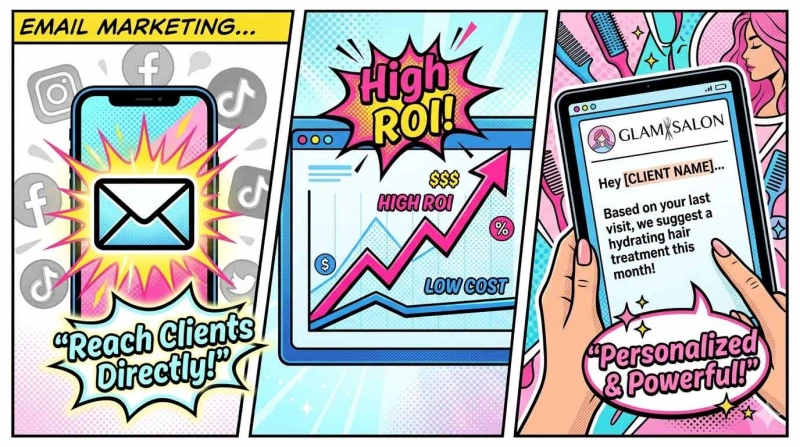
Many salon email guides organize campaigns by holiday. That can produce attractive messages, but it misses the operational advantage of an extension business: your services create natural follow-up moments. Build your automation around the journey below.
| Client stage | Useful data | Best next email | Primary action |
| Inquiry | Method interest, hair goals, consultation status | Consultation follow-up | Book consultation |
| Booked | Service, stylist, appointment date | Preparation and policy reminder | Confirm or prepare |
| New installation | Method, install date, products recommended | Aftercare check-in | Read care guide / reply |
| Active maintenance | Stylist-set due date, last service | Maintenance reminder | Book maintenance |
| Removal or reinstall | Removal date, desired next step | Reinstall planning | Schedule consultation |
| Lapsed | Last visit, former method, consent status | Win-back email | Return or update preferences |
| Loyal/VIP | Visit frequency, spend, referrals | Early access or referral | Refer / book first |
Keep this page focused on email execution. For channel selection, local discovery, reviews, referral programs, and paid promotion, use Alpha’s broader hair salon marketing guide. For staffing, inventory, CRM ownership, and daily operating controls, refer to the hair salon management guide.
The Minimum Client Data You Need
You do not need a complicated data warehouse. You need a small set of reliable fields that your booking or CRM system can use without asking the team to guess.
- Marketing consent status, source, timestamp, and region.
- Client name, preferred stylist, and local time zone.
- Extension method or method interest: tape-in, weft, K-tip, clip-in, or other.
- Consultation date, installation date, last service date, and cancellation status.
- Next maintenance date selected by the stylist at checkout.
- Aftercare guidance or product recommendation already given to the client.
- Last marketing engagement, last booking, and lapsed-client status.
The next maintenance date is the most important field. Installation method matters, but hair growth, application, density, lifestyle, and stylist protocol also matter. Let the professional record the recommended date; let the email system remind the client.
Hair Extension Salon Segmentation That Stays Useful
Segmentation should make the message more relevant, not create dozens of lists that nobody maintains. Start with two dimensions: service method and client stage. Add a third dimension only when it changes the offer or timing.
| Segment | Trigger or rule | Message angle | Do not duplicate |
| Tape-in clients | Method = tape-in; use stylist-set due date | Maintenance, move-up planning, extension-safe care | Do not reproduce the full product or care article |
| Weft clients | Method = weft; use stylist-set due date | Row check, maintenance booking, care support | Link to the dedicated weft maintenance guide |
| K-tip clients | Method = K-tip; use consultation/service record | Bond care, progress check, removal or replacement planning | Link to the K-tip service/product page |
| New clients | First consultation or first booking | Reduce uncertainty and explain the next step | Keep business-plan and service-menu strategy elsewhere |
| Maintenance due | Due date approaching and no booking | Protect the result; make booking easy | Avoid generic discount blasts |
| Lapsed clients | No visit beyond the salon-defined window | Ask what changed and offer a low-friction return | Suppress active clients and recent unsubscribes |
| VIP/referral | Salon-defined visit, spend, or referral rule | Recognition, early access, referral thank-you | Do not expose spend thresholds in client copy |
8 Email Automations for Hair Extension Salons
The templates below are frameworks, not scripts you must send unchanged. Replace bracketed fields, match the tone to your salon, and keep one clear goal in each message.
1. Consultation Welcome and Expectation-Setting
Trigger: A prospect submits an extension inquiry or books a consultation and has agreed to receive the relevant communication.
Send time: Immediately; if no consultation is booked, one follow-up after 2-3 days.
Subject line: Your extension consultation: what happens next
Template: Hi [First name], thanks for telling us about your hair goals. During your consultation, [Stylist] will look at your starting length, density, color, lifestyle, and maintenance preferences before recommending a method. Bring two or three inspiration photos, but expect a recommendation designed for your own hair. If you have questions before the appointment, reply here.
CTA: View consultation details
2. Pre-Appointment Preparation
Trigger: A client books an installation, maintenance, removal, or reinstall appointment.
Send time: Use the salon’s normal confirmation schedule; keep operational reminders separate from promotional broadcasts.
Subject line: Before your [service] appointment on [date]
Template: Hi [First name], your [service] appointment with [Stylist] is booked for [date/time]. Please review the preparation notes and salon policy before you arrive. If your hair, color, medication, or schedule has changed since the consultation, reply so the team can advise you. Need to move the appointment? Use the link below as early as possible.
CTA: Review appointment details
3. Post-Installation Aftercare Check-In
Trigger: A completed installation is recorded.
Send time: Same day for the care recap; 3-7 days later for the comfort and routine check-in.
Subject line: How are your new extensions feeling?
Template: Hi [First name], your new [method] extensions should feel secure and comfortable. Save the care instructions you received today and use the products recommended by your stylist. If you notice discomfort, unusual tension, slipping, matting, or anything you are unsure about, reply with a clear photo instead of waiting for the next appointment.
CTA: Review your aftercare guide
4. Maintenance and Rebooking Reminder
Trigger: The stylist-selected maintenance date is approaching and the client has not booked.
Send time: First reminder 7-14 days before the recorded due date; optional second reminder near the due date.
Subject line: Time to plan your [method] maintenance
Template: Hi [First name], [Stylist] recommended checking your [method] extensions around [recommended date]. Booking now gives you more choice of appointment times and helps the team plan the right service length. If the extensions were removed, you changed methods, or you already booked another way, reply and we will update your record.
CTA: Book maintenance
5. Cancellation or No-Show Recovery
Trigger: An appointment is cancelled and not rebooked, or marked as a no-show.
Send time: Within 1-2 days, after any urgent operational follow-up is complete.
Subject line: Would you like help finding a new appointment?
Template: Hi [First name], we noticed your [service] appointment was not completed. If you still want to continue, use the link below or reply with two days that work for you. If your plans changed, that is completely fine—tell us and we will update your preferences.
CTA: Find a new time
6. Removal and Reinstall Planning
Trigger: A removal is completed without a future installation or consultation on the calendar.
Send time: At the interval selected by the stylist; do not automate a fixed universal wait period.
Subject line: Ready to plan your next extension look?
Template: Hi [First name], when you are ready to discuss your next extension look, we can review your current hair, the result you want, and whether the same method still fits your routine. A fresh consultation is the best place to confirm timing, color, length, and the amount of hair needed.
CTA: Schedule a consultation
7. Lapsed-Client Win-Back
Trigger: No completed appointment for the salon-defined lapsed window, with no future booking and valid marketing permission.
Send time: One email, then one reminder 5-7 days later; suppress the client if they book, unsubscribe, or say they are not interested.
Subject line: Still thinking about your extension routine?
Template: Hi [First name], it has been a while since we last saw you. If your hair goals, budget, schedule, or preferred method changed, we would be happy to start with a conversation—not an automatic repeat of your last service. Reply with what you want now, or book a consultation when it suits you.
CTA: Tell us what you need
8. Birthday or Client Anniversary
Trigger: Birthday month or first-service anniversary, where the client chose to share the date and receive marketing.
Send time: Once per year; use a meaningful perk that fits the salon’s margin and positioning.
Subject line: A little thank-you for your [birthday/anniversary]
Template: Hi [First name], we are glad you are part of [Salon name]. To celebrate your [birthday/anniversary], enjoy [perk] when you book an eligible service by [date]. The perk is optional—the real message is thank you for trusting us with your hair.
CTA: View your thank-you offer
4 Targeted Campaigns to Run Beyond Automation
9. New Method or Service Launch
Audience: Send only to clients whose goals, previous method, or consultation notes make the new service relevant.
Subject line: A new extension option for [goal]
Email angle: Introduce the client problem it solves, who may be a fit, and why a consultation is still required. Link to the service page for full specifications instead of packing every detail into the email.
CTA: Explore the method
10. Seasonal Readiness
Audience: Segment by upcoming travel, events, or known seasonal demand rather than emailing every contact for every holiday.
Subject line: Plan your extensions before [season/event]
Email angle: Explain the booking lead time, maintenance planning, and one practical preparation point. Avoid implying that every client needs a new installation.
CTA: Reserve a consultation
11. Quiet-Chair Availability
Audience: Send to a small, relevant segment that can reasonably use the opening; exclude clients booked already.
Subject line: A [day/time] opening with [Stylist]
Email angle: State the exact service eligibility and appointment window. Protect margin by adding value—a treatment, aftercare check, or consultation upgrade—before defaulting to a large discount.
CTA: Claim the appointment
12. Referral or VIP Early Access
Audience: Send to clients who meet the salon’s loyalty or referral rule.
Subject line: You get first access
Email angle: Thank the client, explain the limited benefit in plain language, and include the terms. If asking for referrals, make the experience easy for the referred friend and never ask clients to share private information without permission.
CTA: See early access
When a campaign needs detailed care advice, link to Alpha’s hair extension aftercare guide or the dedicated weft extensions maintenance guide instead of copying those instructions into this article. For method education, point readers to the tape-in, K-tip, or Butterfly Weft page that matches the message.
A 30-Day Salon Email Marketing Calendar
Triggered emails run continuously, so the calendar below focuses on setup, two planned sends, and improvement. Do not send every row to every subscriber.
| Day | Action | Audience | Goal |
| 1 | Audit consent, suppressions, bounce history, and duplicate contacts | Database | Protect deliverability and trust |
| 3 | Confirm method, last-service, and next-maintenance fields | Active clients | Make triggers usable |
| 5 | Activate consultation welcome and post-install aftercare flows | New inquiries / new installs | Reduce uncertainty |
| 8 | Activate maintenance and cancellation-recovery flows | Due / cancelled clients | Recover bookings |
| 11 | Send one educational email with a relevant care or method link | Matching service segment | Help before selling |
| 15 | Review replies, clicks, bookings, unsubscribes, and errors | Campaign and flow reports | Find friction |
| 18 | Activate win-back flow with a conservative lapsed rule | Lapsed clients only | Restart conversations |
| 22 | Send one targeted offer or availability campaign | Small eligible segment | Fill specific capacity |
| 26 | Test one variable: subject line, CTA, or timing | Comparable split | Learn without muddying results |
| 30 | Document results and choose next month’s two broadcasts | Team | Create a repeatable rhythm |
20 Subject Lines You Can Adapt
- Your extension consultation: what happens next
- Before your [method] appointment on [date]
- How are your new extensions feeling?
- Your aftercare notes, all in one place
- Time to plan your [method] maintenance
- A quick maintenance check from [Stylist]
- Would you like help finding a new appointment?
- Ready to plan your next extension look?
- Has your hair goal changed?
- Still thinking about your extension routine?
- A [day/time] opening with [Stylist]
- Two appointment times just opened for [service]
- Plan your extensions before [event/season]
- A new option for clients who want [benefit]
- Is [method] a fit for your routine?
- Your [birthday/anniversary] thank-you is here
- You get first access to [service/event]
- The care question clients ask us most
- One small habit that protects your extension result
- Reply with your extension question—we will point you in the right direction
How Often Should Hair Salons Send Marketing Emails?
There is no universal frequency that fits every salon. A practical starting point is one or two planned broadcasts per month, plus relevant triggered messages tied to a client’s actions or service record. A client may receive more messages around an active appointment and fewer messages between services.
Use engagement and complaints to adjust. If clicks and bookings fall while unsubscribes rise, reduce broad sends and improve segmentation. Do not count essential appointment confirmations as an excuse to add unrelated promotions; keep the purpose of each message clear.
Design Emails for Booking, Not Decoration
- Write one subject line that accurately matches the message.
- Open with the reason the client is receiving the email.
- Use one main button with a specific action.
- Keep the booking page mobile-friendly and preserve campaign parameters through redirects.
- Add meaningful alt text to images and keep the key message readable when images are blocked.
- Include the salon name, contact details, physical address where required, and a clear unsubscribe option.
- Test the final email on a phone before scheduling it.
Choose a Salon Email Platform by Workflow
The best platform is the one that can use your booking and client data safely. Compare tools by the workflow you need, not by the length of the feature list.
| Capability | Why it matters for extension salons | Question to ask |
| Booking integration | Removes manual exports and lets messages stop after a client books | Can a booking suppress the next reminder immediately? |
| Custom client fields | Stores method, stylist, and recommended maintenance date | Can staff update these fields at checkout? |
| Event-based automation | Starts follow-up from consultation, installation, cancellation, or removal | Which booking events can trigger a flow? |
| Consent and suppression | Keeps permission records and opt-outs consistent | Can consent source and timestamp be exported? |
| Revenue attribution | Connects messages to completed bookings, not just clicks | How does the platform define attributed revenue? |
| Reply handling | Allows clients to ask care or booking questions | Who owns replies, and where are they logged? |
Track the Metrics That Lead to Better Decisions
| Metric | Simple definition | What it tells you |
| Booking conversion rate | Recipients who complete the intended booking / delivered recipients | Whether the email created the desired action |
| Rebooking rate | Eligible clients who book the next recommended service | Whether the retention system is working |
| Revenue per delivered recipient | Attributed completed-service revenue / delivered recipients | Commercial value across campaigns of different sizes |
| Click rate | Unique clickers / delivered recipients | Whether message and CTA earn action |
| Unsubscribe rate | Unsubscribes / delivered recipients | Whether relevance or frequency may be wrong |
| Bounce rate | Undelivered emails / attempted sends | List quality and technical health |
| Reply or support rate | Relevant replies / delivered recipients | Where clients need clarification or reassurance |
Use consistent UTM parameters on booking and content links so campaigns can be compared in analytics. Google’s official guidance explains how campaign URL parameters appear in acquisition reporting. Keep your attribution window and definition of completed revenue documented, and do not change them mid-comparison.
Common Salon Email Marketing Mistakes
Sending every promotion to everyone: Segment by service relevance, lifecycle stage, and booking status.
Guessing the maintenance interval: Store the next date recommended by the stylist.
Using a discount as the only reason to email: Lead with useful timing, care, access, or consultation support.
Copying full aftercare articles into campaigns: Send a concise reminder and link to the dedicated care resource.
Measuring only opens: Prioritize bookings, rebookings, revenue, clicks, replies, and opt-outs.
Leaving flows active after a booking: Add suppression rules so clients do not receive stale reminders.
Buying or scraping lists: Build a permission-based list through consultations, bookings, and clear signup forms.
Treating transactional and marketing messages as the same thing: Define the purpose of each message and apply the rules relevant to your location.
Consent, Privacy, and Unsubscribe Basics
Email rules vary by country and by the type of recipient, so confirm the requirements that apply to your salon. In the United States, the FTC’s CAN-SPAM compliance guide explains requirements such as accurate headers and subject lines, a valid postal address, and a clear opt-out method. In the UK, the ICO’s electronic mail marketing guidance explains consent and the limited existing-customer exception under PECR.
As an operating rule, collect permission clearly, record where and when it was obtained, avoid deceptive subject lines, honor opt-outs, secure client data, and maintain a suppression list. This section is practical marketing guidance, not legal advice.
FAQ
What is the best email marketing strategy for a hair extension salon?
Build triggered emails around the client journey: inquiry, booking, installation, aftercare, maintenance, removal or reinstall, and win-back. Add a small number of segmented broadcasts when there is a specific reason to send.
What is the most important email for client retention?
The maintenance reminder is usually the most operationally valuable because it connects the stylist’s recommended next date to a direct booking action. It works best when the due date comes from the service record, not from a generic interval.
How often should a hair salon send marketing emails?
Start with one or two planned broadcasts each month plus relevant triggered messages. Adjust based on bookings, clicks, replies, unsubscribes, and the natural service cycle of each client.
Should a salon use email or SMS for appointment reminders?
Use the channel the client agreed to receive and the booking system supports. SMS is useful for short, time-sensitive reminders; email is better for preparation, aftercare, education, and messages that need more context. Many salons use both without duplicating every message.
How can a hair salon grow its email list?
Ask for permission during consultation and booking, add a clear website signup, and explain what subscribers will receive. Never make a client believe an operational receipt automatically signs them up for unrelated marketing.
Do rebooking emails need a discount?
No. Convenience, preferred appointment availability, progress protection, and continuity with the stylist are often stronger reasons to act. If you use an offer, make it specific, time-bound, and financially sensible.
How should a salon personalize extension emails?
Use the client’s name only when the data is reliable. More useful personalization includes method, stylist, last service, recommended maintenance date, consultation status, and relevant care resource.
What should a post-installation email include?
Include a short care recap, the relevant aftercare link, warning signs that should prompt a reply, the salon’s contact method, and the next step. Do not overwhelm the client with a full technical manual.
Which pages should this article link to?
Link to broad marketing and management pages for strategy and operations, then to method and aftercare pages when a workflow needs detailed service information. This keeps each page focused and avoids repeating entire sections across the site.
How do I know whether salon email marketing is working?
Track completed bookings, rebooking rate, revenue per delivered recipient, clicks, replies, unsubscribes, and bounces. Compare similar audiences and keep the attribution method consistent.
Turn Email Into a Retention System
Good salon email marketing feels less like advertising and more like thoughtful follow-through. The message arrives because something real happened: a consultation was requested, an installation was completed, a maintenance date is approaching, or a client has been away long enough to need a fresh conversation.
Start with one flow: the maintenance reminder. Once the data and suppression rules work, add aftercare, consultation follow-up, and win-back.
If you are still deciding which extension methods belong on your menu, review Alpha’s guide to adding hair extensions to a salon service menu and its comparison of the best hair extensions for salon use. Then return here and build the emails around the services your team can deliver consistently.