
If your halo feels loose, shifts when you move, shows at the hairline, or presses uncomfortably, the answer is usually not to keep tightening it blindly. A good fit comes from matching the wire circumference to your head, placing the weft in the right position, and letting your natural hair cover the wire without forcing the system into place.
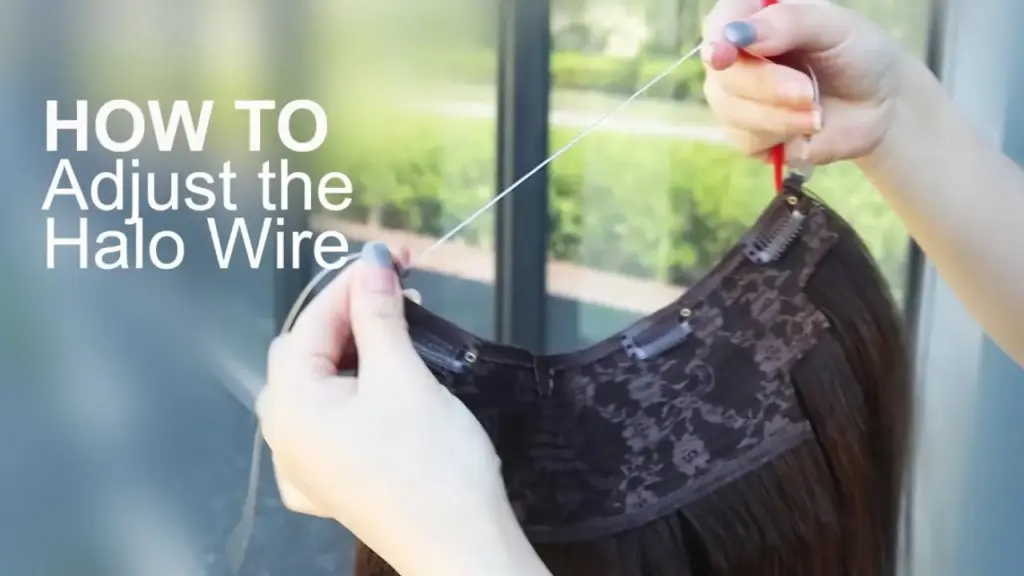
Most modern halo hair extensions are designed with an adjustable wire system. Depending on the product, that may be a hook-and-loop setting, sliding bead, stopper, pulley, or replaceable wire. Adjust the mechanism your product actually uses. Do not permanently bend, kink, cut, or retie the wire unless the manufacturer specifically instructs you to do so.
Quick Answer: What Does a Correct Halo Fit Feel Like?
A correctly adjusted halo should sit comfortably around the crown of your head, gently touch the head rather than dig into it, and stay stable when you turn or lightly shake your head. The back weft should lie flat instead of hanging low or buckling, and the wire should disappear under your top layer of natural hair.
- Secure: the halo does not slide forward or drop when you move normally.
- Comfortable: there is no pinching, headache, pressure point, or pulling sensation.
- Level: the weft sits evenly from left to right rather than dipping on one side.
- Concealed: enough natural hair covers the wire and the top edge of the weft.
- Blendable: the extension density and length transition into your own hair instead of creating a visible shelf.
Before You Adjust: Identify Your Wire System
Halo products do not all adjust in the same way. Look at the points where the invisible wire meets the weft before you pull, bend, or cut anything. If the product came with a fitting card or spare wires, use those instructions first.
| Common system | What you may see | Typical adjustment |
| Hook or loop settings | Small loops, hooks, or notches at the ends of the weft | Move to a shorter setting to tighten or a longer setting to loosen. |
| Slider / bead / stopper | A small movable fitting on the wire | Slide or feed the wire through the mechanism in small increments, then test again. |
| Pulley-style wire | A compact pull-and-lock system | Use the pulley or lock to shorten or release the circumference without forcing the wire. |
| Replaceable wires | Several wire lengths supplied with the product | Choose the wire that gives the best range before fine-tuning the fit. |
| Wire plus optional clips | Adjustable wire with one or more small clips on the weft | Fit the wire first. Use the clips only as designed for extra stability, not to compensate for a badly sized wire. |
If your halo uses a fixed wire with no obvious adjustment point, do not improvise by sharply bending or cutting it. Check whether the design uses a replacement wire or a hidden connection point, or contact the seller for the correct fitting method.
How to Adjust Halo Hair Extensions: Step by Step Guide
- Detangle the halo and your natural hair. Work with dry, detangled hair. Brush the extension from the ends upward while supporting the weft, then brush your own hair so the top section can fall cleanly over the wire.
- Section the top layer. Create a crown section and clip it up so you can see where the wire and weft will sit. Leave enough hair above the wire to cover it once the section is released.
- Start slightly loose and adjust one setting at a time. Shorten or lengthen the wire using the product’s actual adjustment mechanism. Small changes are easier to evaluate than a large pull. If the halo has multiple wire sizes, choose the closest size first and then fine-tune it.
- Place the halo around the crown. Set the wire where it can sit evenly above the ears and around the crown, with the hair weft resting flat at the back. Many designs sit behind the front hairline like a soft headband, but the exact position depends on the weft shape and wire construction.
- Center the weft before tightening again. Check the left and right sides in a mirror. If one side hangs lower, re-center the weft first. Uneven placement is not always a wire-length problem.
- Test the tension. Turn your head, look down, and give a gentle shake. If the halo slides, shorten the wire by one small increment or refine the placement. If you feel pressure, pinching, or a headache, loosen it. Snug is the goal; tight is not.
- Release and lift hair over the wire. Take down the crown section. Use your fingers or the tail of a comb to lift any trapped strands over the wire until the line is covered. Brush lightly through the top layer without snagging the wire.
- Check the blend from the sides and back. A secure fit can still look obvious if the shade, length, or density does not match your natural hair. Check the connection line in daylight and from multiple angles before deciding the wire needs more adjustment.
How Tight Should Halo Hair Extensions Be?

Think “stable without pressure.” A halo does not need to clamp onto the head. The wire should support the weft in the intended position while your natural hair helps cover and stabilize the system.
| Fit | What you notice | What to do |
| Too loose | Slides forward, drops at the back, shifts when you look down, or the wire becomes visible near the hairline | Shorten the wire slightly, re-center the weft, and retest the placement. |
| Correct | Gently touches the head, stays level during normal movement, and feels easy to forget once your hair is released | Leave the setting alone. Focus on blending rather than tightening more. |
| Too tight | Pressure, pinching, indentation, headache, weft buckling, or discomfort above/behind the ears | Loosen one setting or move to a longer wire. Remove the halo if discomfort continues. |
How to Stop Halo Hair Extensions From Slipping?
Slipping is a fit problem first, but not every case is solved by making the wire shorter. Work through the causes in order so you do not over-tighten the halo.
Check the wire size. If the circumference is too large, shorten it gradually and test after each change.
Recheck the position. A wire that is sitting too far forward, too far back, or unevenly can move even when the length is close to correct.
Remove excess oil at the roots. Heavy oils, silicone-rich products, or very slick roots can reduce grip. Keep heavy products away from the area where the wire sits.
Add light texture for very silky hair. A small amount of dry texture or root lift can create grip. You should not need a stiff layer of product.
Use optional clips only if the design includes them. Some halos are built with removable or integrated clips for extra security. Fit the wire correctly first, then use the clips as intended.
Reassess the product weight. A heavy or wide weft can feel unstable on very fine hair if the product is not matched to the wearer. More tension is not always the answer.
Common Halo Fit Problems and Fast Fixes
| Problem | Likely cause | Fix |
| Wire shows near the front | Halo has shifted forward, the wire is too loose, or there is not enough top-hair coverage | Reposition around the crown, adjust slightly shorter if it is sliding, then lift more natural hair over the wire. A finer or different-color wire may help very fine hair. |
| One side sits lower | Weft is off-center or one side is caught under natural hair | Remove the halo, center the weft, and check equal wire tension before changing the wire length. |
| Back weft bulges or lifts | Wire may be too tight, weft is sitting too high, or hair is trapped beneath the base | Loosen slightly, reposition the base flat, and clear trapped strands. |
| Halo slides forward | Wire is too long or placement is unstable | Shorten in small increments, move it to a stable crown position, and reduce heavy root products. |
| Pressure above or behind ears | Wire is too short, placement is too low, or the base is pressing against the ear area | Loosen or reposition higher. Do not keep wearing a painful fit. |
| Halo feels secure but the extension still looks obvious | Color, texture, weight, or haircut does not match the natural hair | Correct the blend instead of tightening the wire. A stylist may need to shape the extension. |
| Fit changes after repeated wear | Wire or adjustment hardware may have stretched or shifted | Inspect the wire and attachment points; replace a worn wire or follow the brand’s refitting instructions. |
Adjusting a Halo for Fine, Thick, or Short Hair
Fine or very silky hair
Use the lightest weight that gives the volume you need, because fine hair has less coverage over the wire and base. A low-profile wire and optional clips can help, but the top layer still needs enough density to conceal the system. If the halo slips on silky roots, improve grip before tightening the wire aggressively.
Thick hair
With thick hair, the fitting problem is often the opposite: the halo may be secure but the extension does not provide enough density to blend through the ends. Choose enough hair weight and width for the natural density. Do not over-tighten the wire to compensate for a density mismatch.
Short or blunt hair
Short hair can expose a visible step between the natural ends and the extension. Positioning matters, but a better blend may require more density, side pieces, or professional layering. If short hair is your main concern, read our Halo Hair Extensions for Short Hair guide before choosing the final weight and length.
When Should You Replace the Halo Wire?
Stop adjusting and replace the wire, or ask the supplier for the correct replacement, when the wire is visibly frayed, permanently kinked, stretched beyond the adjustment range, or no longer holds its setting. Also inspect the point where the wire attaches to the weft. A secure fit depends on both the wire and the attachment hardware.
Do not continue wearing a halo that creates persistent pain or pressure. Remove it, check the setting and product weight, and refit it before the next wear.
For Salons and Hair Brands: Fit Testing Matters Before Bulk Orders
A halo can look excellent in a product photo and still create returns if the adjustment system is confusing. If you source halo hair extensions for clients or a private-label range, test the fit as a product specification – not just as a styling detail.
- Test the same sample on more than one head size and hair density.
- Record the usable wire-length range and the number of adjustment positions.
- Check how easily the slider, loop, hook, bead, or pulley can be adjusted without tools.
- Confirm whether spare wires or optional clips are included and how replacements are ordered.
- Wear-test the sample for slipping, pressure, wire visibility, weft stability, and adjustment drift.
- Include a simple fitting card or QR-code tutorial in retail packaging so customers do not have to guess how the wire works.
For a product-level overview, see Alpha Hair’s Halo Hair Extension page. If you are developing a branded halo range, confirm wire construction, weight, shade system, spare parts, packaging, and fit instructions during sampling rather than after the first bulk order.
FAQ
How do I know if my halo hair extensions are too loose?
They are probably too loose if the halo slides forward, drops at the back, shifts when you look down, or exposes the wire near the hairline. Shorten the wire one small setting at a time and retest the position.
How tight should halo hair extensions be?
They should feel snug enough to stay stable but not tight enough to create pressure, pinching, or a headache. If you notice discomfort, loosen the wire or change the placement.
Should I bend the halo wire to fit my head?
Not as a universal rule. Many halos are designed to be adjusted with loops, hooks, beads, sliders, pulleys, or replacement wires. Use the mechanism provided by the product and avoid permanent bending unless the manufacturer specifically tells you to do it.
Can I cut a halo extension wire if it is too long?
Only if the product instructions explicitly allow cutting and explain how to secure the new end. Many adjustable systems do not require cutting, and cutting too early can remove future adjustment range.
Why does my halo wire keep showing?
The halo may be sliding forward, sitting in the wrong place, or lacking enough natural-hair coverage. Reposition it around the crown, correct the tension, and use a tail comb to lift trapped hair over the wire. Very fine hair may need a lower-profile wire or additional support.
Can I use clips to keep a halo in place?
Yes, if the halo is designed with optional or integrated clips. Fit the wire first, then use the clips for extra stability. Clips should support a correct fit, not compensate for a wire that is obviously the wrong size.
Do I need to adjust my halo every time I wear it?
Usually you only need to confirm the fit. Readjust if the wire has shifted, the hardware has loosened, the product has been stored differently, or your hairstyle changes where the halo sits.
Final Fit Check
The best way to adjust halo hair extensions is to make small, reversible changes and test the result on your head. Match the wire to the product’s actual adjustment system, center the weft, aim for stable rather than tight tension, and solve blending problems separately from fit problems.
A halo that is correctly fitted should stay in place during normal movement without pressure and should disappear once your natural hair is released over the wire.
If you are comparing halo constructions for salon supply, retail, or private label, start with fit testing before you approve the final specification. A clear adjustment system, stable weft, suitable hair weight, and easy customer instructions can reduce fitting confusion and make the product easier to sell with confidence.