
Micro loop hair extensions are individual extension strands supplied with a small loop and bead already attached. During installation, you pull a section of natural hair through the loop, slide the bead into position, and clamp it with extension pliers. You do not need glue, keratin, tape, or heat to create the attachment.
When you ask, “What are micro loop hair extensions?”, the short answer is that they are ready-to-install, strand-by-strand extensions with a loop and bead already fitted. That simple design is why micro loops are popular with stylists, salons, and hair brands.
You get the free movement of a strand-by-strand method, a discreet attachment, and a product that can be repositioned or reused when the hair remains in good condition.
However, the terms micro loop, micro ring, micro bead, micro link, and I-tip are often used as though they mean exactly the same thing. They are closely related, but the product format and installation method are not always identical. Understanding the difference helps you select the right extension for your clients, your salon menu, or your private-label range.
Key Takeaways
- Micro loop hair extensions are pre-looped individual strands with a bead attached for faster strand-by-strand installation.
- The method uses mechanical pressure rather than heat, glue, tape, or keratin adhesive.
- Micro loop, micro ring, micro bead, micro link, and I-tip describe related products or systems, but they are not always interchangeable.
- Healthy medium-to-thick hair usually provides the most reliable base. Fine, fragile, or actively shedding hair needs a professional assessment.
- Hair quality, strand weight, bead construction, tip consistency, color accuracy, and quality control all affect the finished result.
- You should treat installation, maintenance, and removal as professional services rather than assuming a heat-free method is automatically damage-free.
What Are Micro Loop Hair Extensions?
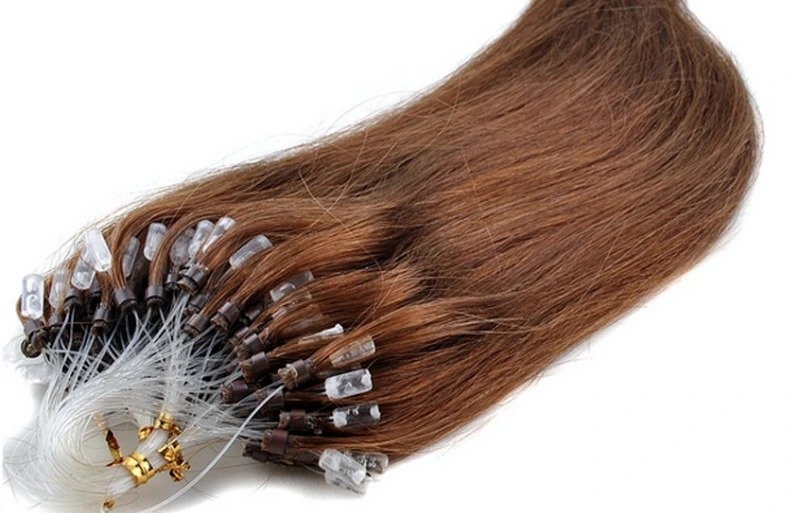
Micro loop hair extensions are small bundles of extension hair with a bonded tip, a pre-attached bead, and a temporary plastic or nylon loop. The loop acts as a threader. It helps you draw the client’s natural hair through the bead without using a separate pulling needle.
Once the natural hair is inside the bead, you pull the loop away, move the bead to the correct position, and close it with pliers. The bead holds the extension strand and the natural hair together.
You may also see this product described as pre-looped microlink hair extensions, micro ring loop hair extensions, easy-loop extensions, or micro bead loop extensions. The wording changes between markets, but the defining feature is the pre-attached loop-and-bead system on each strand.
For a closer look at available formats, colors, textures, and customization options, explore Alpha’s micro loop hair extensions product page.
What Parts Make Up a Micro Loop Strand?
A micro loop extension looks simple, but each component affects installation and wear.
| Component | What It Does | What You Should Check |
| Extension hair | Adds length, volume, texture, or color | Hair origin, cuticle alignment, texture match, color consistency, and shedding |
| Bonded tip | Keeps the extension hair together as one strand | Uniform size, secure bonding, neat finish, and flexibility |
| Micro bead or ring | Secures the extension to natural hair | Size, shape, metal quality, coating, color, and silicone lining if specified |
| Pulling loop | Threads natural hair through the bead | Strength, smooth edges, and easy release during installation |
| Strand weight | Determines how much extension hair is supported by each natural section | Consistent weight and suitability for the client’s hair density |
Tip: Do not judge a micro loop product only by how soft the loose hair feels. The tip, bead, loop, and strand-weight consistency can have just as much influence on the stylist’s experience and the client’s comfort.
How Do Micro Loop Hair Extensions Work?
Micro loop extensions work through a small mechanical attachment. A stylist sections the natural hair, threads a controlled amount through the loop, slides the bead into place, and clamps the bead closed. The extension then moves with that section of natural hair.
Because the strands are installed individually, you can control placement more precisely than with a wide weft. You can add volume through selected areas, fill uneven density, create highlights without coloring the natural hair, or build a full-head transformation.
The method does not require heat or adhesive. This avoids the heat exposure of hot fusion and the adhesive used in tape-in systems. It does not, however, remove every risk. Incorrect section size, excessive strand weight, poor placement, over-tight clamping, missed maintenance, or rough removal can still place stress on the natural hair.
For detailed placement and tool instructions, see the full micro loop installation guide.
Micro Loop vs Micro Ring vs I-Tip vs Micro Link Weft
You will often find these terms grouped together in supplier catalogs and search results. The clearest way to separate them is to distinguish the product format from the attachment system.
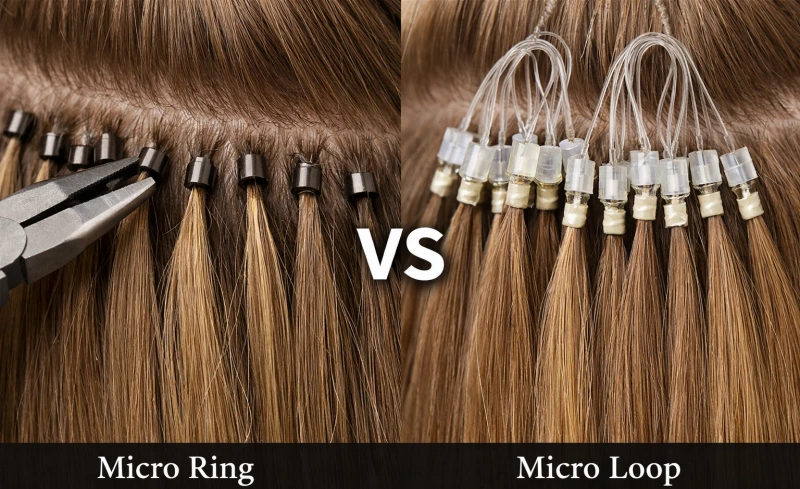
| Term | Product Format | How It Is Installed | Main Difference |
| Micro loop extensions | Individual tipped strands with a loop and bead already attached | Natural hair is pulled through the loop, then the bead is clamped | Faster preparation because the threader and bead are pre-attached |
| I-tip extensions | Individual strands with an I-shaped bonded tip | A separate bead is loaded onto natural hair, then the I-tip is inserted and clamped | Gives the stylist more control over bead choice and setup |
| Micro ring or micro bead extensions | A bead-based attachment system | Small rings or beads secure an individual strand or another compatible format | Describes the attachment method more than one universal product |
| Micro link extensions | A broad market term for extensions installed with microbeads or microtubes | May include I-tips, pre-looped strands, or beaded wefts | Covers several bead-based techniques |
| Micro link weft | A weft rather than individual strands | Beads create an attachment base for rows of weft hair | Faster coverage, but less strand-by-strand placement freedom |
| Nano ring extensions | Individual strands attached with smaller rings and nano tips | A nano tip is inserted into a very small ring and clamped | More discreet hardware, with different tip and tool requirements |
You can review Alpha’s micro link hair extensions guide for the wider product family, compare the dedicated micro ring hair extension page, or examine I-tip hair extensions when you need a strand without a pre-attached loop.
Note: Searchers frequently use these names interchangeably. Your product page, packaging, and sales materials should still describe the exact construction so buyers know what they are ordering.
Why Do Stylists and Buyers Choose Micro Loop Hair Extensions?
Faster Strand-by-Strand Preparation
The built-in loop and bead remove several setup steps. Your stylist does not need to load a loose bead onto a separate pulling tool before every strand. This can make micro loops easier to organize and faster to install than a standard I-tip system, especially for stylists who prefer a ready-to-use product.
No Heat or Adhesive at the Attachment Point
You do not melt keratin or apply tape adhesive. That makes the method useful when you want a cold application and a removable mechanical bond. It also keeps adhesive residue out of the installation and removal process.
Natural Movement and Flexible Placement
Each extension moves with a small section of the client’s own hair. When the color, texture, weight, and placement are correct, the result can look natural and remain flexible for styling.
You can distribute strands where they are needed instead of adding the same amount of hair across an entire row. This makes micro loops useful for targeted volume, length, highlights, and corrective blending.
Repositioning and Reuse
A stylist can open the bead, remove or move the strand, and install it again with a suitable replacement bead. The extension hair may be reused across several maintenance cycles if it remains smooth, strong, and well maintained.
The practical lifespan depends on the original hair quality, processing history, home care, heat exposure, texture, and how often the hair is reinstalled. Reusable does not mean unlimited use.
Broad Product Customization
For a salon brand or distributor, micro loops can be developed in different lengths, shades, textures, strand weights, bead colors, pack sizes, and packaging formats. This gives you room to build a product around a specific client profile rather than selling one generic specification to everyone.
Are Micro Loop Extensions Right for Your Hair?
Micro loops are not automatically suitable for every client. You need enough healthy natural hair to support each extension strand and enough density to conceal the beads.
Medium to Thick Hair
Healthy medium-to-thick hair is usually the most straightforward match. It provides a stronger support base, gives the stylist room to create balanced sections, and helps conceal the attachment points.
Fine or Thin Hair
Fine hair requires more caution. You may need lighter strands, smaller attachment points, fewer extensions, or a different placement pattern. If the natural hair is fragile, sparse, breaking, or actively shedding, a bead-based strand method may not be the right choice.
Do not try to solve fine-hair visibility by placing beads too close to the hairline or using sections that are too small. Both choices can increase tension and make the attachments easier to see.
Curly, Coily, or Textured Hair
Texture matching matters as much as attachment choice. You should select extension hair that behaves like the client’s natural texture after washing and styling. A poor texture match increases daily styling work and may lead to excessive heat use.
Sensitive Scalp or Existing Hair Loss
A client with scalp inflammation, bald areas, unexplained shedding, traction-related thinning, or a medical hair-loss condition should seek professional medical or trichology advice before installation. A no-glue method is not a treatment for hair loss and should not be presented as one.
| Natural Hair Condition | General Suitability | Main Consideration |
| Healthy medium or thick hair | Often suitable | Correct sectioning, weight, and concealment |
| Healthy fine hair | Possible with caution | Lightweight strands and conservative placement |
| Very fragile or breaking hair | Often unsuitable | Risk of tension and further breakage |
| Active shedding or scalp condition | Delay installation | Professional assessment is needed first |
| Curly or coily hair | Possible | Accurate texture match and appropriate care |
How Are Micro Loop Hair Extensions Installed?
A professional installation usually follows five basic stages:
- Consultation and matching: You assess the natural hair, desired result, color, texture, length, total weight, and maintenance commitment.
- Preparation and sectioning: The hair is clean, dry, detangled, and divided into controlled rows.
- Threading: A small natural-hair section is pulled through the pre-attached loop and bead.
- Positioning and clamping: The bead is placed with enough space for movement and closed with the correct pliers pressure.
- Blending and checking: The stylist trims and blends the extension hair, then checks comfort, concealment, and even weight distribution.
A full installation can take several hours, depending on strand count, density, placement plan, and stylist experience. The goal is not to finish as quickly as possible. The goal is to create balanced sections and a comfortable attachment.
Do Micro Loop Extensions Damage Hair?
Micro loop extensions do not use glue or heat, but that does not make them risk-free. The health of the natural hair depends on product weight, section size, installation, daily handling, maintenance, and removal.
You reduce the risk when you:
- match strand weight to the client’s natural density;
- leave appropriate space between the bead and scalp;
- distribute the extensions evenly;
- avoid installing over weak, broken, or inflamed areas;
- brush and wash without pulling the attachments;
- attend move-up appointments on schedule; and
- use professional pliers and removal techniques.
You increase the risk when extensions are too heavy, clamped too tightly, left to grow out for too long, tangled at the roots, or pulled out without opening the bead correctly.
For a deeper explanation, read the dedicated guide on whether micro loop extensions damage hair.
How Long Do Micro Loop Hair Extensions Last?
You should separate the maintenance cycle from the lifespan of the extension hair.
The attachment usually needs professional checking and repositioning as the natural hair grows. Many clients return in roughly six to eight weeks, although the correct timing varies with growth rate, shedding, placement, and home care.
The extension hair itself may be reused for several cycles. High-quality human hair can remain serviceable for months when it is washed gently, protected from excessive heat, and stored correctly between installations. Processed shades, very long lengths, and curly textures may show wear sooner than less processed straight or wavy hair.
For detailed lifespan factors, read the guide on how long micro loop hair extensions last. For home-care instructions, see the micro loop maintenance guide.
How Many Micro Loop Extensions Do You Need?
There is no reliable full-head number without knowing the weight of each strand and the client’s starting hair.
A stylist may use fewer strands for targeted volume and more for a full length-and-volume service. Common full-head plans may fall around 100 to 150 individual strands, but that figure is only meaningful when you also know whether each strand weighs 0.5 gram, 0.8 gram, 1 gram, or another amount.
You should calculate the plan using:
- the client’s natural density and perimeter;
- the desired length and volume;
- the weight of each extension strand;
- the total extension weight;
- the haircut and blending requirement; and
- the amount of natural hair available to support each attachment.
Read the full-head quantity guide for a more detailed calculation.
What Makes High-Quality Micro Loop Hair Extensions?
Two products can use the same attachment method and perform very differently. As a salon, distributor, or private-label buyer, you should evaluate the complete product rather than relying on a “Remy” label alone.
Full Cuticle, Consistent Human Hair
Aligned cuticles help the hair move in one direction and reduce friction between strands. You should ask the supplier to explain what its quality grade means, how the hair is processed, and whether quality is consistent across repeat orders.
Alpha hair extension manufactures 100% full cuticle Remy extensions and wigs and has supplied OEM/ODM programs since 1990. That manufacturing perspective is relevant because a strong sample is only useful when the same specification can be reproduced in bulk.
Consistent Strand Weight
Uneven strand weight creates an uneven installation. Some natural sections may carry more extension hair than others, even when the stylist uses the same sectioning method.
Ask for the target weight per strand and the accepted production tolerance. Then weigh a sample selection rather than checking only the total pack weight.
Secure, Neat Tips
The bonded tip should hold the extension hair securely without being bulky, sharp, or inconsistent. Loose fibers around the tip can increase shedding and make installation untidy.
Reliable Beads and Loops
The bead should close evenly without cracking, exposing sharp edges, or reopening too easily. The loop should be strong enough to pull natural hair through smoothly and release without snagging.
If you specify silicone-lined beads, check the lining position and consistency. If you offer several bead colors, test whether the finish remains stable during normal handling and washing.
Accurate Color and Texture Matching
A shade number is not enough. You should compare undertone, root depth, blend pattern, and batch consistency under more than one light source. For textured products, wash-test the sample to see how the pattern behaves after the factory finish is removed.
Practical Quality-Control Evidence
Ask your manufacturer what is checked before shipment. Useful controls may include:
- incoming hair inspection;
- strand-weight checks;
- tip-bond consistency;
- combing and shedding tests;
- wash and tangle evaluation;
- color comparison against approved standards;
- loop and bead function checks; and
- final quantity and packaging inspection.
| Buyer Check | Why It Matters | Simple Sample Test |
| Hair alignment and feel | Affects tangling and movement | Wash, air-dry, and comb the sample several times |
| Strand-weight consistency | Affects comfort and even distribution | Weigh individual strands from different packs |
| Tip security | Affects shedding and installation | Pull gently at the tip and inspect loose fibers |
| Bead performance | Affects hold and removal | Clamp, reopen, and reclamp sample beads |
| Loop strength | Affects installation speed | Thread different section sizes and check for snapping or snagging |
| Color consistency | Affects repeat orders | Compare multiple packs against an approved color standard |
| Texture recovery | Affects styling and client expectations | Wash the hair and observe the natural dried pattern |
Tip: Approve a complete reference sample, including the hair, tip, bead, loop, label, and packaging. Do not approve only a loose-hair swatch.
How Should You Choose Micro Loop Extensions for a Salon or Brand?
Start with the client or market you want to serve. A product designed for healthy thick hair should not automatically be marketed as the best option for fragile fine hair.
Define the User Profile
Decide whether your main buyer is a professional salon, an experienced extension stylist, a beauty retailer, or an end consumer. Professional products can use more technical instructions, while retail packs need clear warnings, aftercare guidance, and strand-count information.
Build a Complete Specification
Your purchase specification should cover:
- hair grade and processing level;
- length and length tolerance;
- texture and finish;
- color standard;
- weight per strand;
- strands and total grams per pack;
- tip dimensions;
- bead material, size, lining, and color;
- loop material and strength;
- labeling and barcode requirements; and
- packaging format.
Test Before Bulk Production
Install sample strands on appropriate training hair or salon models. Check threading speed, bead closure, comfort, slippage, shedding, washing behavior, color match, and removal. A desk inspection cannot reveal the complete service experience.
Keep Claims Accurate
Avoid claims such as “completely damage-free,” “suitable for every hair type,” or “lasts one year” without explaining the conditions. Clear, qualified language builds more trust with salons and consumers.
If you are comparing factories or building a vendor shortlist, the micro loop hair extension suppliers guide can support the next stage of your research.
Why Work Directly With a Micro Loop Hair Extension Manufacturer?
Working with a manufacturer gives you more control over the details that influence repeat orders. You can discuss the hair specification, strand weight, bead option, color range, pack size, labels, inserts, and packaging as one complete product.
You should also ask whether the supplier can support:
- sample packs and color rings;
- custom shades and mixed colors;
- multiple strand weights;
- salon or retail packaging;
- private labels and printed inserts;
- stable repeat-production standards;
- low-volume market testing; and
- scalable bulk production.
Alpha provides OEM/ODM support for hair brands, salon chains, wholesalers, retailers, and new entrants. When you request a sample, provide your target market and desired specification. This allows the manufacturer to recommend a more relevant construction instead of sending a generic product.
Conclusion
If you are still asking, “What are micro loop hair extensions?”, remember the core idea: they are pre-looped individual strands that attach to natural hair with a small bead. You get a cold, glue-free installation, flexible placement, natural movement, and the option to reposition or reuse good-quality extension hair.
The product is not defined by the hair alone. The bonded tip, bead, pulling loop, strand weight, color accuracy, and manufacturing consistency all influence how the extensions install, feel, and perform.
If you are choosing micro loops for a client, start with hair and scalp suitability. If you are sourcing them for a salon or brand, start with a written specification and a complete sample test. In both cases, accurate matching and professional handling matter more than broad promises.
FAQ
Are micro loop and micro ring hair extensions the same?
They are closely related, but the terms do not always describe the same product. A micro loop strand normally includes a pre-attached loop and bead. Micro ring or micro bead extensions refer more broadly to the attachment system. Always check the actual product construction.
Are micro loop extensions suitable for thin hair?
They may work for some healthy fine-hair clients when the stylist uses lightweight strands and conservative placement. They are not a good automatic choice for very fragile, sparse, breaking, or actively shedding hair.
Can you reuse micro loop hair extensions?
Yes, you can often reuse good-quality human hair after professional removal, cleaning, inspection, and bead replacement. The number of uses depends on hair quality, processing, care, and the condition of each strand. See the complete guide to reusing micro loop hair extensions for more detail.
Can you wash and style micro loop extensions normally?
You can wash and heat-style human-hair micro loops, but you should avoid rough circular washing, heavy products on the beads, excessive heat, and pulling at the attachment points. Follow your stylist’s aftercare plan.
Do micro loop extensions show in the hair?
Correct color matching, controlled placement, enough natural density, and small neat attachments help conceal the beads. They may be visible in very fine hair, high ponytails, exposed partings, or poorly planned installations.
How often do micro loop extensions need maintenance?
Many clients need a professional check and move-up after about six to eight weeks. Natural growth, shedding, hair type, strand count, and home care can make the correct interval shorter or longer.