
A client asks for fuller ends, an invisible seam, and a comfortable install. You place a Genius Weft and a hand-tied weft side by side. Both look slim. Both can create beautiful, natural movement. Yet once you begin measuring the row, the differences become obvious.
The real Genius Weft vs hand tied decision comes down to construction, cutability, density, return hair, placement, and the way you build your service menu. Genius Weft gives you more freedom to cut a row to the client’s head shape. Hand-tied weft gives you a delicate, low-density option that is easy to layer for dimensional color.
Neither one is automatically better for every client. The better weft is the one that lets you achieve the result without overloading the natural hair.
Genius Weft vs Hand Tied: The Quick Answer
Choose Genius Weft when you want a thin, cuttable weft with concentrated density and little or no return hair. It is especially useful when you need a precise row width, fewer folded ends, or more hair in fewer tracks.
Choose hand-tied weft when you want a very lightweight, flexible weft that you can stack in multiple colors. It suits clients who need soft, controlled volume, provided you can work with full weft widths or fold the weft instead of cutting it.
Here is the short version:
| Factor | Genius Weft | Hand-Tied Weft |
|---|---|---|
| Construction | Modern micro-stitched or hybrid weft construction | Hair is tied by hand onto a continuous foundation thread |
| Can you cut it? | Usually yes; verify the supplier’s cut test | Usually no; cutting may cause unraveling |
| Return hair | Typically none or very little | Usually present at the top of the weft |
| Density | More hair can be concentrated in one track | Lower density makes shade layering easier |
| Row fitting | Easy to trim to the exact section width | Must be ordered to size, folded, or stacked |
| Scalp feel | Flat and smooth when weight is selected correctly | Very light, but return hair may bother a sensitive scalp |
| Best salon use | Custom fitting, efficient installs, and fuller results | Fine blending, dimensional color, and delicate volume |
| Main limitation | A dense weft can be too heavy if you overfill a fine-hair row | Less cuttable and more delicate during handling |
Product specifications vary by factory and collection. Before you add either weft to your menu, test the actual seam, grams, width, shedding, and cut performance rather than relying on the product name alone.
What Is a Genius Weft?
A Genius Weft is an ultra-thin professional hair weft designed to combine a flat profile with the strength and customization stylists need at the chair. Unlike a tape-in, it does not use an adhesive tab. You normally install it on a professionally built row using beads, thread, or another trained weft method.
The feature stylists notice first is cutability. With a properly made Genius Weft, you can trim the band to match the width of the section without the whole weft unraveling. That gives you cleaner ends and more control around the temples, occipital area, and smaller perimeter sections.
Most Genius Weft hair extensions are also made without the short folded return hair found on traditional hand-tied wefts. This creates a smoother top edge and can reduce the prickly feeling some clients experience as return hair grows out.
Because the seam is slim but the hair can be relatively dense, you may achieve a full result with fewer layers. That can make your placement plan cleaner, but it does not mean you can ignore weight. You still need to match the grams on each row to the density and strength of the client’s natural hair.
What is a Hand Tied Weft?
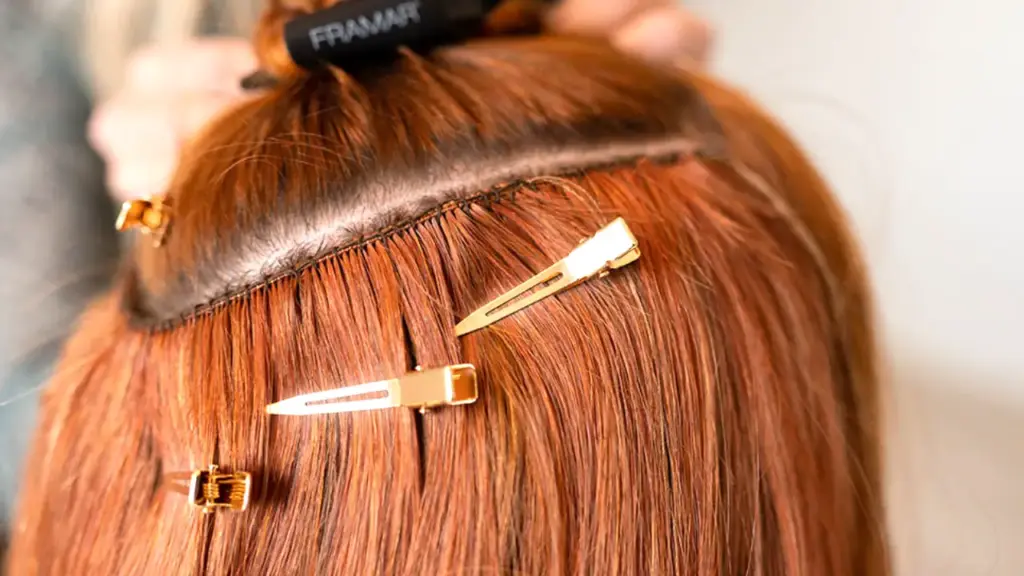
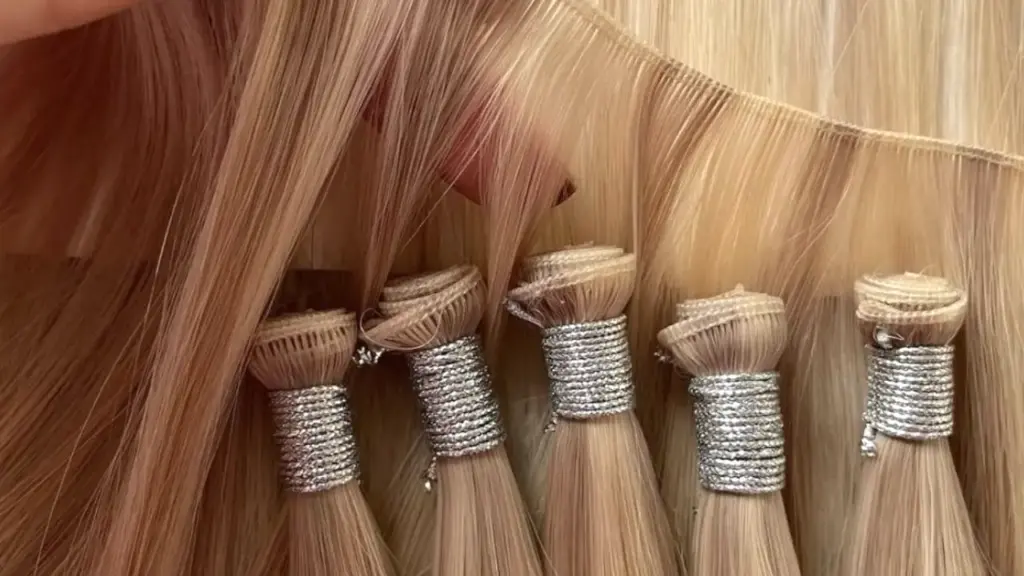
A hand-tied weft is made by tying small groups of hair onto a continuous foundation thread by hand. This labor-intensive construction produces a soft, flexible weft that lies close to the head and moves naturally.
Hand-tied weft extensions are usually light and less dense per piece. That is useful when you want to stack several shades without creating one solid block of color. You can let a rooted shade, a highlight, and a lowlight show through the row instead of having one dense weft cover the others.
The trade-off is that the foundation thread runs across the weft. If you cut through it, the cut end can loosen and shed. Some stylists seal or stitch an end after cutting, but the safer approach is to follow the manufacturer’s instructions. In most cases, you order the width you need, fold the weft, or stack full pieces.
Traditional hand-tied construction also creates return hair: short strands folded over at the top of the seam. Many clients never notice it. A client with a very sensitive scalp, however, may describe itching or a rough feeling near the row.
Genius Weft vs Hand Tied: 9 Differences That Matter in the Salon
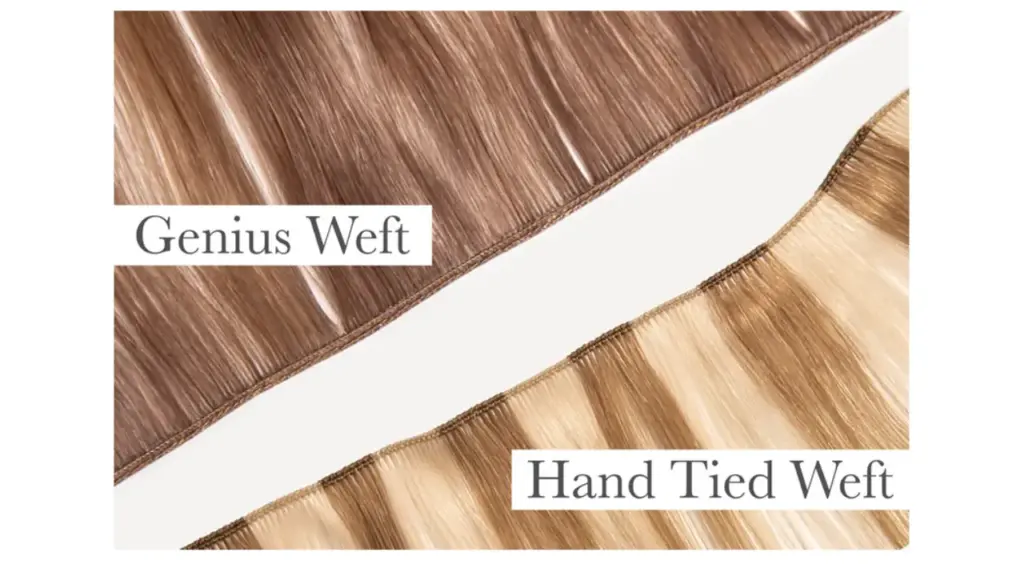
1. Construction and seam stability
Genius and hand-tied wefts can both look thin, but the hair is anchored differently.
In a Genius Weft, the top is engineered so the band can stay stable after trimming. In a hand-tied weft, the knots depend on a continuous thread. Once that thread is cut, nearby hair may no longer have a secure anchor.
This difference affects more than durability. It changes how you measure, section, inventory widths, and handle leftover hair.
2. Cutting and customization
This is the clearest difference in the Genius Weft vs hand tied comparison.
You can usually cut a Genius Weft at the point your row ends. You do not need to force a standard-width weft into a section that is slightly shorter, and you avoid a bulky folded corner. The offcut may also be usable in another section if it is wide enough and passes inspection.
You should not casually cut a traditional hand-tied weft. Instead, plan your widths before the appointment or fold the weft without creating a hard corner. If your service depends on highly customized mini-sections, this limitation can slow your workflow.
Always perform a cut test on a sample. “Genius Weft” is not a universal manufacturing standard, and weak construction can still shed at the cut edge.
3. Return hair and scalp sensitivity
Return hair is the short hair near the top of a hand-tied weft. It is a natural result of folding hair over the foundation thread during production. On a well-made weft, the return hair is controlled and neat. On a poor one, it can be coarse, uneven, or long enough to tangle with the client’s natural hair.
A Genius Weft typically has no return hair or only a minimal amount. The top feels smoother when you run your finger along the seam. For clients who have complained about itching with traditional wefts, that difference can be meaningful.
Still, scalp comfort depends on the complete install. A smooth seam will not compensate for rows that are too tight, beads that are poorly placed, or too much weight attached to too little natural hair.
4. Density and the number of layers
Genius Weft is often denser than hand-tied weft. You may get more hair on one narrow band, which helps when a client wants noticeable fullness without a tall stack of wefts.
Hand-tied weft is generally less dense per piece. That gives you finer control. You can build volume gradually, mix several shades, and stop when the blend looks right.\
Do not confuse density with quality. A lower-density hand-tied weft is not inferior; it is simply a different tool. For a fine-haired client who wants soft movement rather than maximum grams, lower density may be exactly what you need.
5. Seam profile and visibility
Both options can sit flat when they are installed well. Genius Weft gives you an advantage at row ends because you can cut the band to fit and avoid folding excess width. Hand-tied weft has an exceptionally delicate seam, but a folded end or a large stack can create localized bulk.
Visibility also depends on placement. You need enough natural hair above the row to cover the seam, especially around the crown and sides. A thin product installed too high will still show.
When you compare samples, check the seam height, thickness, flexibility, and consistency from one end to the other. A single thickness claim in millimeters tells you less than a real sample on a curved mannequin head.
6. Installation workflow
“Hand-tied” describes how the weft is made. It does not automatically describe the installation method. You can sew a hand-tied weft or a Genius Weft onto several types of beaded rows, hidden rows, or braided foundations, depending on your training.
For Genius Weft, you can measure the section, cut the required width, inspect the cut edge, and sew it onto the foundation. This can reduce time spent folding and managing standard widths.
For hand-tied weft, you plan the row around the supplied width. You may stack or fold pieces, taking care not to create pressure points. The install can be beautiful, but it rewards careful preparation.
Both products require professional training. Your row design, bead spacing, stitch pattern, weight distribution, and tension matter more to hair safety than the name printed on the package.
7. Suitability for fine, medium, and thick hair
For very fine hair, a light hand-tied weft can be a strong option because you can add volume in small increments. A lower-density Genius Weft can also work well if you use fewer grams and create a conservative row.
For medium-density hair, you have the most flexibility. Choose based on the desired result, scalp sensitivity, shade plan, and maintenance habits.
For thick hair, the concentrated density of Genius Weft can help you create enough fullness to blend the natural perimeter and ends. You may need fewer layers than you would with a lighter hand-tied product.
There is no safe rule that says one weft type always belongs on fine hair and the other belongs on thick hair. Assess strand strength, density at the row, shedding history, scalp health, lifestyle, and the length-to-weight change the client wants.
8. Maintenance, removal, and reuse
The maintenance schedule is usually set by the installation method and the client’s growth—not by the weft name alone. Many clients return for a move-up in roughly six to eight weeks, but your professional assessment should set the timing.
At every appointment, inspect:
- matting or trapped shed hair near the row;
- bead or thread movement;
- tension, tenderness, or redness;
- seam damage and shedding;
- dryness, split ends, and color fade;
- the condition of the natural hair supporting the row.
Both types can be reused when the human hair remains healthy and the seam is intact. Hair origin, cuticle alignment, processing, home care, heat exposure, and removal technique have a bigger effect on useful life than the label “Genius” or “hand-tied.”
9. Cost and value
Genius Weft may have a higher product cost than a basic machine weft, while hand-tied weft carries the labor cost of hand construction. Actual pricing varies by hair grade, length, grams, drawing ratio, color work, and supplier.
For your salon, value is not just the cost per pack. Calculate the cost per finished service:
- How many grams do you need?
- How many shades and widths must you stock?
- How much hair is left over after fitting?
- How long does the install take?
- Can you reuse offcuts or full wefts?
- How often do you see warranty issues or early shedding?
A product that costs more per piece may still improve your margin if it reduces waste and chair time. A lighter hand-tied range may be more profitable if dimensional color services are a major part of your business.
Which Weft Should You Choose?
Use the client’s goal and the reality of their hair—not a trend—to make the decision.
Choose Genius Weft when:
- you need to cut the weft to an exact row width;
- the client wants more fullness with fewer layers;
- folded row ends would create visible bulk;
- the client is sensitive to return hair;
- you want one adaptable stock width for varied head shapes.
Choose hand-tied weft when:
- you want to layer several colors with visible dimension;
- the client needs gradual, lightweight volume;
- you can plan with full widths or custom-order the correct size;
- your team is comfortable folding and stacking delicate wefts;
- the client values soft movement more than maximum density.
If you are still unsure, order a sample of each and build the same row on a mannequin. Measure the finished width, grams, height, flexibility, installation time, and shedding. The side-by-side test will tell you more than a product photo.
Are Genius Wefts or Hand-Tied Wefts Safer?
Both can be safe. Both can also cause breakage if they are too heavy, too tight, poorly placed, or left without maintenance.
The safest choice is the weft you can match to the client’s natural density and install without concentrating tension. A dense Genius Weft may let you use fewer layers, but those grams still need adequate support. A light hand-tied weft may feel delicate, but stacking too many pieces on a weak row can create the same problem.
Before installation, postpone or modify the service if you see active hair loss, scalp inflammation, open areas, severe breakage, or insufficient density to support the planned weight. When necessary, ask the client to consult a qualified medical professional.
During the consultation, explain that discomfort is not something they should “wait out.” Persistent pain, bumps, headaches, or pulling require a prompt check.
How to Compare Wefts Before You Buy Wholesale?
If you buy for a salon, brand, or distribution business, compare specifications that affect real service performance. A low quote means little if the seam varies from batch to batch.
Ask your manufacturer for:
- Hair specification. Confirm whether the hair is full-cuticle Remy, the drawing ratio, origin category, texture, and processing level.
- Weight tolerance. Weigh several pieces and check whether grams remain consistent across lengths and colors.
- Seam measurements. Compare height, thickness, flexibility, and straightness along the full width.
- Cut test. Cut Genius Weft samples in several places, brush them, wash them, and inspect the edges for shedding.
- Return-hair control. Check the length and texture of return hair on hand-tied samples.
- Wash and heat test. Test tangling, shedding, dryness, color transfer, and texture recovery after repeated cycles.
- Color consistency. Compare stock shades under salon lighting and against the supplier’s color ring.
- Batch repeatability. Reorder the same specification before committing to a large launch.
- Packaging and traceability. Confirm labels, length, grams, shade codes, care instructions, and batch identification.
Alpha Hair Extension manufactures professional weft extensions for salons, brands, wholesalers, and distributors. You can request samples, stock shades, and OEM/ODM support before planning a larger order. Alpha’s Genius Weft is available in 50g pieces, lengths from 8 to 30 inches, and more than 59 stock shades, with specifications confirmed before production.
Care Tips You Can Give Every Weft Client
Good aftercare protects the natural hair, the row, and the reusable weft.
- Brush from the ends upward while supporting the attachment area.
- Separate rows gently each day to prevent matting.
- Wash the scalp without scrubbing or piling the lengths on top of the head.
- Keep heavy oils, masks, and conditioner away from beads and thread.
- Dry the roots and row fully before sleeping.
- Use heat protectant and moderate tool temperatures.
- Sleep with dry hair in a loose braid or low ponytail.
- Return on the maintenance schedule you set.
Give these instructions in writing. Clients remember more when they can take the routine home.
FAQ
Is Genius Weft the same as hand-tied weft?
No. They can both create a thin, discreet result, but the construction is different. Genius Weft is typically designed to be cut without unraveling and to avoid return hair. Hand-tied weft is tied onto a continuous thread and is usually not cuttable.
Can you cut hand-tied extensions?
You generally should not cut a traditional hand-tied weft because the foundation thread can unravel. Follow the manufacturer’s instructions. If a supplier claims its hand-tied product is cuttable, test a sample before using it on a client.
Is Genius Weft good for thin hair?
It can be, provided you select an appropriate density and do not overload the row. For extremely fine or fragile hair, a lighter hand-tied option may offer more control. Your consultation and weight plan should decide.
Which weft is less bulky?
Both can lie flat. Genius Weft is easier to trim to the exact row width, so you can avoid bulky folded ends. Hand-tied weft has a delicate seam, but stacked or folded pieces can add thickness in one spot.
Which one sheds less?
A well-made Genius Weft should remain stable after a proper cut. A hand-tied weft can shed if its foundation thread is cut or damaged. Overall shedding also depends on hair processing, stitching quality, brushing, washing, and removal.
How long do Genius Weft and hand-tied weft extensions last?
There is no reliable lifespan based on construction alone. High-quality human hair can be reused across multiple installs, but longevity depends on hair quality, color processing, heat, home care, maintenance, and the condition of the seam. Inspect the weft before every reinstall.
How often do clients need a move-up?
Many weft clients return in about six to eight weeks. Growth rate, row method, density, and home care can shorten or extend that interval. Set the schedule after you inspect the install and natural hair.
Which weft is better for color blending?
Hand-tied wefts are often easier to layer because each piece is less dense, allowing several shades to remain visible. Genius Weft can also create dimensional blends, especially when your supplier offers rooted, balayage, piano, and mixed colors.
Is Genius Weft more expensive than hand-tied weft?
It depends on the hair specification and supplier. Compare equal length, grams, hair grade, drawing ratio, and color complexity. For a salon, include installation time and leftover waste in the real cost.
Final Verdict
In the Genius Weft vs hand tied comparison, Genius Weft wins on cutability, precise fitting, smooth return-hair-free construction, and concentrated density. Hand-tied weft wins when you want low-density layering, delicate movement, and fine control over dimensional color.
You do not need to choose one for every client or every service. A strong weft menu can include both. Use Genius Weft where customization and efficiency matter, and keep hand-tied weft for clients who benefit from lightweight layering.
If you are building a salon range or private-label collection, start with samples. Test the seam, cutability, color, shedding, and wash performance under your own service conditions. Contact Alpha Hair Extension to compare Genius Weft and hand-tied specifications, request sample support, or plan an OEM/ODM weft collection for your market.