
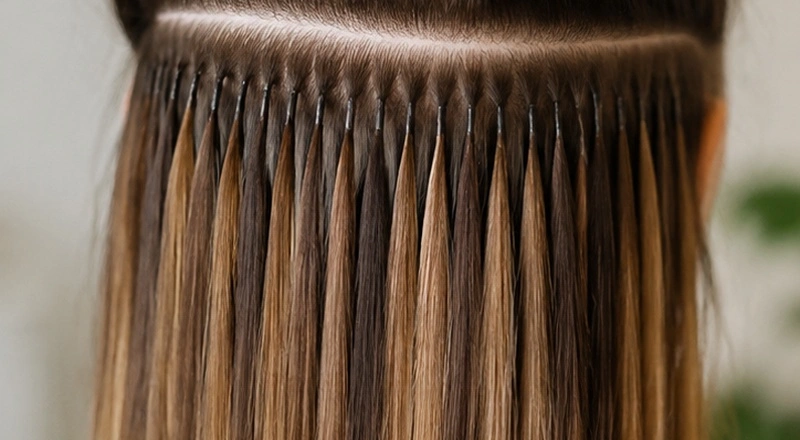
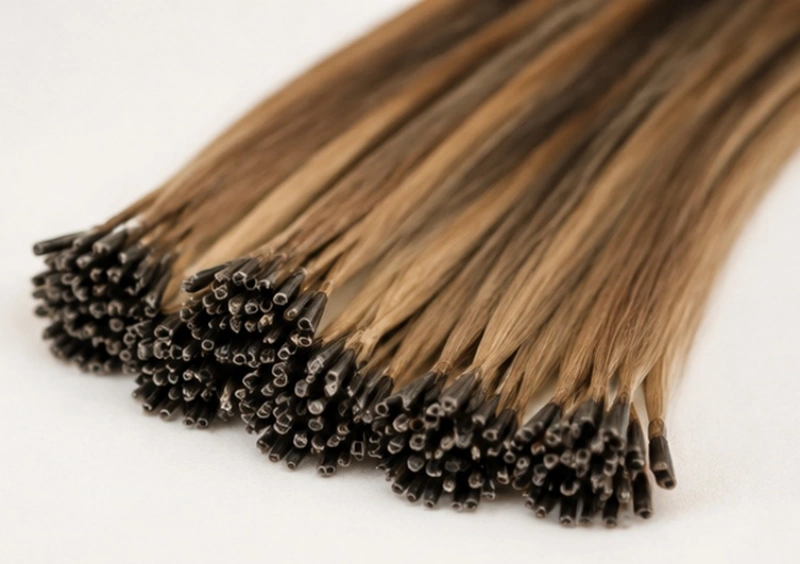
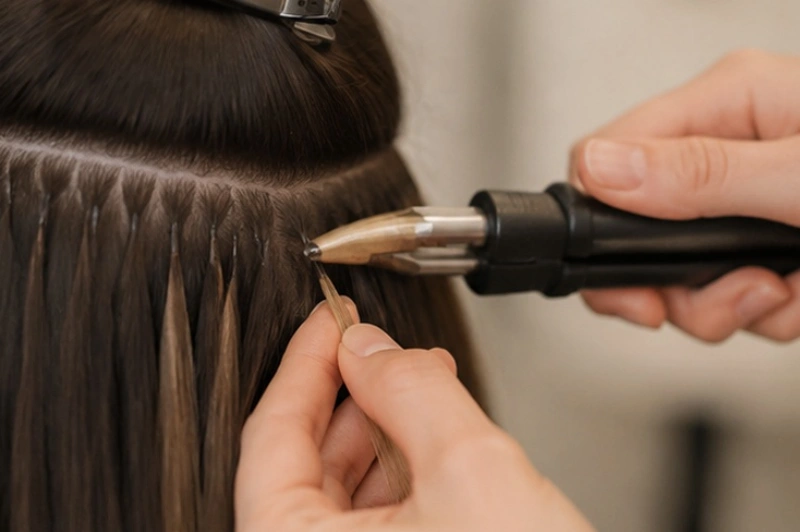
K tip hair extensions are individual extension strands with a small, pre-formed keratin-based bond at the top. During a professional installation, a stylist softens each tip with a controlled fusion tool, wraps or shapes the bond around a carefully sized section of natural hair, and lets it cool. The result is a discreet attachment that moves strand by strand instead of sitting in a tape panel or weft row.
You may also hear K tips called keratin tip extensions, keratin bond extensions, pre-bonded extensions, or fusion hair extensions. The terms overlap, but products can differ in bond shape, strand weight, keratin formula, hair quality, and application protocol. That is why choosing the right product and a trained installer matters as much as choosing the method itself.
This guide explains how K tips work, their main benefits and limitations, who they suit, how long they last, and what proper care looks like. It also gives salon owners, retailers, and hair brands a practical way to evaluate human hair K tip extensions without repeating the detailed comparisons and product specifications covered elsewhere on the Alpha Hair website.
How Do K Tip Hair Extensions Work?
Each K tip strand combines extension hair with a small keratin-based attachment. A stylist starts with clean, dry hair, creates precise sections, and selects a natural-hair section that can safely support the weight of the extension. The bond is softened with a professional heat tool, formed around the section, and allowed to cool until secure.
Because the strands are installed one by one, the stylist can control placement, color distribution, and density more precisely than with a continuous weft. Individual movement also helps the finished hair fall naturally. However, the same precision makes the service time-consuming and unsuitable for DIY application.
K Tip, Keratin Bond, and Fusion: Do These Terms Mean the Same Thing?
In everyday salon language, they usually describe the same general method from different angles: “K tip” refers to the pre-bonded tip, “keratin bond” refers to the attachment, and “fusion” refers to the heat-application process. They should not be treated as proof that every brand uses the same materials or technical specifications.
Always follow the manufacturer’s approved tool, temperature range, section size, wear schedule, and removal protocol.
What Makes K Tips Different From Other Hair Extensions?
K tips are best understood as an individual-bond method. They are not automatically better than I tips, U tips, tape-ins, or wefts; they simply solve different placement and lifestyle needs.
| Method | Attachment | Main Strength | Main Consideration |
| K tip | Heat-softened keratin bond | Precise placement and independent movement | Professional installation and removal |
| I tip | Bead or micro ring; no heat | Hair may be repositioned or reused | Beads can be visible or require tightening |
| U tip | Heat-fused U-shaped bond | Secure bond for fuller sections | Bond shape and weight must suit the client |
| Tape-in | Adhesive tape panels | Faster application and flat panels | More frequent move-up appointments |
For a method-specific comparison, read our K tip vs I tip extension guide or the U tip vs K tip guide. Those pages cover the trade-offs in more detail, while this article stays focused on understanding K tips themselves.
K Tip Hair Extensions Pros and Cons
The right choice depends on the condition of the natural hair, the client’s goals, and the quality of the installation. Here is the balanced view.
Benefits of K Tip Extensions
- Natural movement: Individual strands move independently, which can create a soft, flexible finish.
- Customized placement: A stylist can adjust density around the sides, crown, perimeter, or face-framing areas.
- Discreet bonds: Well-formed bonds can be small and easy to conceal when placement matches the haircut and density.
- Color dimension: Multiple shades can be blended strand by strand without placing every color in the same row.
- Styling flexibility: Quality human hair can usually be curled, straightened, and styled, provided direct heat is kept away from the bonds.
- Long wear: A professionally installed set can remain secure for several months when the system and aftercare are appropriate.
Limitations to Consider
- Time and cost: A full installation may take several hours and requires skilled labor, quality hair, removal, and possible retipping.
- Not a DIY method: Incorrect sectioning, bond size, heat control, or removal can increase breakage and tension.
- Daily care matters: Bonds need regular separation, gentle brushing, thorough drying, and protection from oil-heavy products.
- Not ideal for every client: Active shedding, scalp irritation, severe breakage, or heavily compromised hair may rule out the method.
- Reuse is not guaranteed: Some high-quality hair can be professionally retipped, but the original bond is not simply reapplied and not every system supports reuse.
Who Are K Tip Extensions Best For?
K tips are often chosen by clients who want semi-permanent length, targeted volume, or discreet strand-by-strand placement. They can work well for fine, medium, thick, straight, wavy, curly, and coily hair when the extension weight, bond size, texture, and placement are matched to the individual.
A professional consultation should evaluate natural density, strand strength, scalp condition, chemical history, current shedding, haircut, lifestyle, and maintenance habits. Small bonds offer more placement options, but they do not make every client a safe candidate.
K Tip Extensions for Fine or Thin Hair
Fine hair describes strand diameter, while thin hair usually describes density. Either can affect the number, weight, and placement of K tips. Lighter strands and carefully distributed bonds may work for some clients, but low-density or fragile areas should never be overloaded. Persistent shedding, tenderness, or breakage needs attention before an extension service. For a fuller suitability checklist, see whether keratin extensions are good for thin hair.
K-Tip Extensions for Black Hair and Textured Hair
K tips can be used on Black hair and textured hair, including curly and coily patterns, but success depends on texture matching and a stylist who understands shrinkage, porosity, density, detangling, and heat history. The extension should blend with the client’s usual finished texture, not only with freshly straightened hair.
Care instructions should also fit the client’s wash schedule and styling routine rather than forcing a one-size-fits-all plan.
What Happens During a Professional K Tip Installation?
A responsible K tip service is more than melting a bond. Although exact instructions vary by system, the salon process normally follows these stages:
- Consultation and assessment. The stylist checks the scalp and natural hair, clarifies the desired result, and decides whether the method is appropriate.
- Color, length, texture, and density planning. The stylist selects the hair, estimates the amount needed, and maps placement around the haircut and natural density.
- Preparation and sectioning. Hair is cleansed as required by the system, dried fully, and divided into clean working sections.
- Controlled bonding. Each tip is softened with the approved tool and formed around a correctly sized section of natural hair without placing the bond directly on the scalp.
- Cutting and blending. The extension hair is shaped into the client’s haircut so the finished result looks intentional.
- Aftercare and removal planning. The client leaves with brushing, washing, drying, styling, sleep, and follow-up instructions, plus a professional removal window.
Salons planning a full head should calculate total density rather than copy a fixed strand count. Our guide to how many grams of hair extensions are needed explains the variables behind that estimate.
How Long Do K Tip Hair Extensions Last?
Many professionally installed K tip sets are worn for about three to four months, but there is no single universal lifespan. Some brand protocols recommend a shorter window, while others allow longer wear. Natural hair growth, shedding, bond condition, section size, product quality, lifestyle, and home care all affect the schedule.
Separate two different questions: how long the installed bonds should stay in the hair, and whether the extension hair can be used again. The first is a client-safety and maintenance decision. The second depends on the condition of the hair and whether the product is designed for professional retipping. Read our detailed guide to how long keratin hair extensions last for a deeper breakdown.
K-Tip Hair Extensions Maintenance Guide
Good maintenance protects the natural hair, keeps bonds separated, and preserves the appearance of the extension hair. Always follow the installer’s and manufacturer’s instructions, but these habits form a practical baseline:
- Brush gently every day. Support the bond area with one hand, begin at the ends, and work upward with an extension-safe brush.
- Wash in an upright position. Clean the scalp without scrubbing bonds together, then let water flow downward through the lengths.
- Keep conditioner and oil away from the bonds. Apply nourishing products mainly from the mid-lengths to the ends unless the system says otherwise.
- Dry the attachment area thoroughly. Leaving bonds damp for long periods can encourage tangling and make maintenance harder.
- Protect bonds from direct heat. Use a heat protectant on the hair and keep irons or curling tools away from the keratin attachments.
- Separate bonds and check for matting. Follow the stylist’s instructions and book a check if bonds slip, twist, clump, or feel uncomfortable.
- Protect hair during sleep and swimming. A loose braid or ponytail can reduce friction; rinse and dry the hair after exposure to salt or chlorine.
For a complete routine, use our keratin extension care guide and the step-by-step advice on washing keratin hair extensions.
Can K Tip Extensions Damage Natural Hair?
K tips are not automatically damaging, but no extension method is risk-free. Problems are more likely when the client is not suitable, the bond is too heavy for the natural section, placement creates tension, bonds are left in too long, home care is inconsistent, or removal is rushed.
A little awareness during the first days is different from ongoing pain. Persistent tightness, scalp soreness, headaches, redness, or sudden shedding should not be ignored. Contact the installer and have the bonds assessed. Never pull, peel, or cut out K tips at home. Professional removal uses the compatible remover and tool to break down the bond before the strand is gently released.
Our dedicated guide explains when K tips may damage hair and how to reduce the risk. When the wear period ends, follow a professional keratin extension removal process rather than improvising.
How to Choose Quality Human Hair K Tip Extensions?
A neat bond cannot compensate for poor extension hair. Whether you are a stylist buying for a client or a brand evaluating a supplier, check the complete product rather than choosing by shade photo or price alone.
- Hair construction: Ask whether the hair is human hair, Remy, and cuticle-aligned. Consistent cuticle direction helps reduce friction, matting, and tangling.
- Strand weight and bond size: Specifications should state grams per strand, bond dimensions, pack weight, strand count, and available lengths.
- Bond consistency: Tips should be uniform from strand to strand and workable with the approved fusion tool and temperature protocol.
- Color and texture accuracy: Evaluate the shade under realistic lighting and test whether straight, wave, curl, or coily textures behave consistently after washing.
- Shedding and wash performance: A sample should be washed, dried, brushed, and heat-styled before a salon or brand commits to a larger order.
- Documentation and support: Reliable suppliers provide clear specifications, care guidance, compatible tools or removers, quality-control standards, and responsive after-sales support.
If you need the technical difference between product grades, review our full-cuticle Remy, Remy, and non-Remy comparison. For a commercial shortlist, the best K tip extensions guide is designed for that buying intent rather than the definition intent of this page.
What Salons and Hair Brands Should Ask a K Tip Supplier?
For a salon, distributor, retailer, or private-label brand, K tip sourcing is a specification and quality-control decision. Before ordering, confirm the hair grade, origin claims, cuticle handling, bond formula, strand weight, tip size, color tolerance, texture process, length range, pack configuration, minimum order quantity, lead time, and replacement policy.
Request representative samples rather than relying on one perfect strand. Test multiple colors and lengths through washing, drying, brushing, heat styling, bonding, and removal. Use a written scorecard so your team compares suppliers on the same criteria. Our guide to evaluating hair extension samples before a bulk order provides a repeatable process.
Alpha Hair manufactures professional K tip hair extensions with customizable specifications for salons, distributors, and hair brands. Buyers can discuss strand weight, length, shade, texture, bond format, packaging, and sampling. If you are building your own collection, explore OEM and private-label hair extension manufacturing instead of treating a consumer guide as a wholesale specification sheet.
FAQ About K Tip Hair Extensions
Are K Tip Hair Extensions Permanent?
No. K tips are semi-permanent extensions. They remain attached for a planned wear period and must be professionally removed before the bonds grow too far from the scalp or begin to mat.
Can You Wash Your Hair With K Tip Extensions?
Yes. Wash gently with products recommended by your stylist, avoid rubbing the bonds together, keep heavy conditioner and oils off the attachment area, and dry the bonds thoroughly.
Can K Tip Hair Extensions Be Reused?
Sometimes. The original bond is removed, and suitable extension hair may be professionally retipped if the manufacturer allows it and the hair remains in good condition. Some systems are intended for one installation, so confirm before purchase.
How Much Do K Tip Hair Extensions Cost?
The final price varies by hair quality, length, density, number of colors, location, stylist experience, installation time, blending, removal, and whether retipping is possible. A consultation and written quote are more useful than a universal price range.
How Do I Find K Tip Hair Extensions Near Me?
Look for a licensed or appropriately qualified extension professional who is trained in the specific K tip system being used. Ask to see healed grow-out and post-removal work, not only same-day before-and-after photos. Confirm that consultation, aftercare, check-ups, and removal are part of the service plan.
Are K Tips Suitable for Short Hair?
They can be, if the natural hair is long and dense enough to cover the bonds and blend with the extension length. Short layers, low-density perimeters, or an abrupt length change may require a more conservative plan.
Final Takeaway
K tip hair extensions are a customizable, strand-by-strand method that uses heat-softened keratin bonds to add length, volume, or targeted density. Their main strengths are discreet placement, natural movement, and color flexibility. Their main demands are professional application, careful client selection, consistent daily maintenance, and planned removal.
For clients, the safest result begins with a trained stylist and a realistic assessment of the natural hair. For salons and hair brands, the best result begins with clear product specifications, repeatable sample testing, and a supplier that can maintain consistent hair and bond quality from order to order.